Showing posts with label Science. Show all posts

Friday, July 31, 2015

The Blue Moon

Today we will see a "Blue Moon"! Its a rare phenomenon when we have more than the general amount of full moons in a season. As it happens so infrequently, hence the expression about something happening "once in a blue moon".

Lunar activity is always compelling. Even though we have actually stepped on its surface, it still hold magic for us, with people recording its unusual or spectacular activity.

For example, on May 18, 1761, the moon was plunged into darkness for an hour and a half, in a deep total eclipse that showed the moon 45% of its diameter inside the Earth's shadow. Because of the Earth's atmosphere at the moment and evidence of volcanic eruption in the Indonesian Island of Halmahera, the moon looked red in color! You can imagine the fear and trepidation.

Nevertheless, as spooky as it might have been, it must also have been remarkable. So, don't forget to look up into the sky tonight. You may be able to see the Blue Moon!

Friday, July 24, 2015

Indiana Jones, 18th Century Style

Recently, (I don't know what possessed me), but I got out my DVD series of the wonderful Indiana Jones saga.  I started looking at Raiders of the Lost Ark, and soon I was hooked. I have now watched them all, and looking at the "bonus" disc of the making of each of the films. It really is an addictive thing. For those interested, there is an actual site, indianajones.com that of course, promotes the sale of all the films, but also has information about archeology in the 1930's, Indy's bio, the villains, etc. etc.

As we know, archaeology is the study of human activity through the ages, primarily focused on recovering artifacts, cultural data, human remains, religious practices, architecture, and analyzing the findings, not only for their place in history  at the time but as a benchmark as it relates to other time periods. We get to understand peoples of a different age, but how they relate to the people we are today. 

I looked into the history of archaeology, especially through the 18th century, and can report the following:
The antiquarian movement of the 17th Century gave rise to a nationalistic endeavor to turn private collections over to museums for the general public's education and pleasure. By the way, antiquarians were those interested in personal collections of artifacts and curios, usually kept in their homes, libraries filled with bones, fossils, or shards of pottery  from ancient civilizations. One could play the "scientist" and boast a bit about their particular collection to those who were invited to view!  


People were hired by museums to go out and look for collections, and entice the owners to give up their personal treasures for the greater good, and perhaps with their name attached to the particular museum gallery in which they were to be displayed. One man, Giovanni Battista Belzoni, was hired by Henry Salt, British consul to Egypt, to gather antiquities for England from far away lands. London, of course, to this day, has one of the greatest collections of Egyptian antiquities in the world.

The father of archaeological excavation is William Cunnington, who lived from 1754-1810.  He undertook excavations in Wiltshire, England around 1798, along. His work was funded by a number of patrons.  

Cunnington's terms for categorizing archaeological finds are still used today. He kept meticulous records of Neolithic and Bronze Age barrows. The first use of a trowel as an excavation tool are sited in a letter Cunnington wrote to one of his wealthy patrons, Richard Colt Hoare, in 1808.

A casual aside: One of the Freemason's tools is the trowel, symbolic of  "the more noble purpose of spreading the cement of brotherly love and affection, that cement which unites us into one sacred band or society of friends, among whom no contention should ever exist, but that noble contention, or rather emulation, of who can best work and best agree."
The Masonic ideal was very popular in the 18th century. Among some of the notables were Founding Fathers George Washington, musician Mozart was a mason. Alexander I Zsar of Russia, poet Robert Burns, naval hero John Paul Jones, and
Madame de Xaintrailles, Republican heroine of the French Revolution.


Wednesday, July 15, 2015

Raise a Glass to New Horizon!

With the Pluto flyby last night, which I find very exciting, I wanted to pay tribute to astronomy, and found this quaint bit from the 18th Century. Apparently there is a Astronomer's Drinking Song, sung at a dinner in 1798 at the Mathematical Society in London, to honor Mr. Fletcher, the society's solicitor. The society had begun giving public lectures on mathematical or philosophical subjects. An action was brought against the organization for holding unlicensed public forums. The charge was £5000. Mr. Fletcher refused to pay! And so in his honor as a tribute, the drinking song was composed!

Here below is a good deal of it!

Whoe'ver would search the starry sky,
Its secrets to divine, sir,
Should take his glass - I mean, should try
A glass or two of wine, sir!
True virtue lies in golden mean,
And man must wet his clay, sire;
Join these two maxims, and 'tis seen
He should drink his bottle a day, sir!

Old Archimedes, reverend sage!
By trump of fame renowned, sir,
Deep problems solved in every page,
And the sphere's curved surface found, sir;
Himself he would have far outshone,
And borne a wider sway, sir
Had he our modern secret known,
And drank a bottle a day, sir!

When Ptolemy, now long ago,
Believed the earth stood still, sir!,
He never would have blundered so,
Had he but drunk his fill, sir:
He'd then have felt it circulate,
And would have learnt to say, sir,
The true way to investigate
Is to drink your bottle a day, sir!

Copernicus, that learned wight,
The glory of his nation,
With draughts of wine refreshed his sight,
And saw the earth's rotation;
Each planet then its orb described,
The moon got under way, sir;
These truths from nature he imbibed
For he drank his bottle a day, sir!

(more vodka needed)

The noble Tycho placed the stars,
Each in its due location;
He lost his nose by spite of Mars,
But that was no privation;
Had he but lost his mouth, I grant
He would have felt dismay, sir,
Bless you! he knew what he should want
To drink his bottle a day, sir!

Cold water makes no lucky hits;
On mysteries the head runs:
Small drink let Kepler time his wits
On the regular polyhedrons:
He took to wine, and it changed the chime,
His genius swept away, sir,
Through area varying as the time
At the rate of a bottle a day, sir!

(Many more verses continue the chronology; then the final verse)

How light we reck of those who mock
By this we'll make to appear, sir,
We'll dine by the sidereal clock
For one more bottle a year, sir:
But choose which pendulum you will,
You'll never made your way, sir,
Unless you drink - and drink your fill, -
At least a bottle a day, sir.


So, with that, I think it's time to toast one up to NASA's New Horizon team and their incredible flyby accomplishment.

Monday, July 6, 2015

Phisick: Medical Remedies from 1710

The other night, I watched another episode of The Crimson Field, a new PBS series about a British military field hospital located in France during the first World War. So very interesting. Last night one part of the story revolved around an experimental procedure for saving a soldier's leg from amputation. It was real quite hideous to watch, very graphic, with the soldier writhing in pain. The doctor finally admits that it is an experiment with an outside-chance effort to save the leg. The soldier, after much anger and consideration, decides to give it a try.

Experimentation in medical practice is nothing new, and oft times leads to a correct answer, and to medical advancement.

In the 18th century, much earlier however, some "cures" seem downright barbaric, ridiculous and cruel, but sometimes had their positive effect, even if for the wrong reason. Giving someone a dose of a poisonous substance, could in turn purge the body of an unknown toxin, and by chance, result in a cure. A lot of it was trial and error.

In 1710, a book of remedies was published, called A Book of phisick, 1710-1725. It includes a collection of medical cures and remedies written in English, of 217 pages. It is even said to contain even a "receipt for a person to make her husband love her". Now, that's quite a prescription! (if it works). haha

Most of the remedies involve the use of plants and minerals to cure everything from bad breath to cancer. Some of these treatments are still found today in non-Western areas, but used extremely carefully.

Here's a quirky one:
A remedy for breast cancer - "ingredients like sage, bay leaves, chamomile, and red roses, all left to mature in a dunghill for precisely eight days". I guess then it was topically applied. Good luck!

Here's another for "The Gripe" (upset stomach):
"The recipe required a gallon of brandy and as many mature poppy leaves--which would have been heavy with opium--as could be stuffed into a container. The concoction was left to steep for a few days, strained, and then mixed with some nice liquors to make it more palatable;--3 or 4 spoonfuls at a time is enough. And for children, just two, with a little water. It was probably incredibly effective--unconscious people are seldom bothered by stomach upset."

So there you have it, "modern medicine"! I guess we shouldn't be too critical. After all, what good does some of our current trends do, i.e. snail slime facial treatments! As a matter of fact, when I was recently in London, while I was in a Boots Chemist store (an all-purpose drug store), I came upon a shelf teaming with snail slime products. I was horrified! I took a picture of it, too! See below. I almost feel sorry for the poor snails who have given their lives for science of this type!

Friday, June 26, 2015

Be Careful What We Wish For

Currently at work, I am researching the history of energy efficiency. Everyone thinks that this issue had its real foundation in the 1970's with what was at that time, considered non-mainstream, basically a "tree-hugger's" ideal. But over the past 40 years, various and evolving forms of energy efficiency have become the norm for the home, workplace, transportation, health maintenance.

But surprising, I find information about energy efficiency going back to the 18th Century. Perhaps, in those days it was a matter of producing as much energy as possible. At this time economic and technological development is linked to shifts in energy sources, i.e., from coal (a solid fuel) to oil (liquid) or natural gas (gas). From the beginning of history up until the 18th Century, man's use of energy came from muscular or biomass (wood) sources. Most work was done by manual labor or animals,  using wood for heating and cooking. Windmills and watermills were employed but not to great extent. Eventually, the Industrial Revolution would change all that with steam or coal powered engines.

In 1712 - the first Steam Engine was developed in England to Pump Water Out of Coal Mines.


In 1767 - the first solar thermal collector was developed by Swiss scientist Horace de Saussure, to generate energy, with simple foods being cooked in black cast iron pots, and heat collectors in the form of hot boxes to cook food. Horace was ahead of his time!


1790's - coal began to take the place of current sources of energy... Wood, wind, water, beeswax, tallow, sperm-oil - all these were displaced steadily by coal and derivatives of coal...

1800 - the process of electrolysis is discovered , with English scientists William Nicholson and Sir Anthony Carlisle discovering that applying electric current to water produced hydrogen and oxygen gases. This process was called electrolysis. This was an important historic step in the development of hydrogen energy and the hydrogen fuel cell.


Of course, as the Industrial Revolution took hold, its great benefits also held the beginnings of the dreaded black skyline, creating the London combination of smoke and fog, or "smog" as it became known. The rest is history, and now we have the massive clean up underway.  We need to be careful, or be careful what we wish for! 

Monday, April 27, 2015

Discovery of Planets

The other day the news featured a bit about Pluto, and is it or is it not a planet? This is a controversy that goes back a while, and the planet is so far away that it is hard to truly document its path. In 2006, Pluto was demoted, by recent debate says it IS a planet. In the next few months, the New Horizon probe spacecraft, will "visit" Pluto and we will have an answer...maybe.

Anyway, I looked into 18th Century info on the planets, and find the following:
Sir Frederick William Herschel, a German-born British scientist/astronomer first reported the discovery of Uranus on April 26, 1781. It was initially believed to be a comet. He also, in 1787, reported 2 satellites orbiting Uranus, Titania and Oberon. we later reported four more.
From August to November 1789, he noted two moons of Saturn, Mimas and Enceladus.

Herschel became interested in astronomy in 1773, constructing his own large telescope in 1774, spending nine years doing sky surveys. In 1781 he realized that Uranus was a planet and not a star. It was the first discovery of a planet since antiquity, and he himself became a star (celebrity) overnight. King George III appointed him as "Court Astronomer", and he was elected to the Fellows of the Royal Society, and given grants to develop new telescopes.

Later, His catalog of nebulae were published in 1802, including over 2,500 objects flying around "out there", and another 5,000 by 1820. He also discovered the existence of infrared radiation. He was knighted in 1816, and died in 1822. His only son, John, continued his work.  

Tuesday, April 7, 2015

Elementary, my dear Glover!

Here's an interesting bit concerning The Battle of Waterloo:

Recently, archeologists have identified the skeletal remains of a man who died at the Battle of Waterloo. If scientists are correct, these remains are those of an unknown soldier who died near the Lion's Mound in 1815. Historian Gareth Glover is credited with cracking the case using artifacts buried around the body, and the remains of a soldier from 200 years ago. The remains supposedly belong to Friedrich Brandt, a 23 year old soldier who served with the Kind's German Legion of George III at the time of his death.
The remains were found in 2012, and there was also found a ball from a musket at rest in the area of the ribcage! Unlike the recent discovery and formal burial of Richard III, Brandt did not have any living blood relatives to call on for DNA comparison.
 
Glover dug deep, as it were. He was able to track troop formations that fought on the fateful day, and determines that the soldier was Hanoverian trained and likely fought with the British to liberate portions of the homeland that had come into Napoleon's control. There were only two soldiers who had "CB' as initials in their name, and the remains in particular had an "F' that was faded with time. Glover also used payroll records and coins found near the remains to determine that the money was likely one week's pay. That's very Sherlock Holmes of him, don't you
think!?

Thursday, March 12, 2015

Bye, Bye Frizzies!

I recently saw an article, a historical account, about hair products and appliances. I noticed a strange appliance called the hygrometer, and read that it was developed in the 1700's. I decided to look into this.

It appears that in 1783, a Swiss physicist and geologist named Horace Benedict de Saussure, created the first hair hygrometer. Apparently, it measures humidity of human hair! Horace lived from 1740 to 1799, was an aristocrat, and an Alpine traveler! He also, by the way, founded alpinism, or the art or science of mountain climbing! He even offered a prize for the first scaling of Mont Blanc. He made the third attempt about 1788.

He spent a great deal of time researching the Alps, seeing them as the grand key to the true theory of the earth, giving close attention to the rocks and fossils. He carried barometers and thermometers to the summits of various alpine mountains and estimated the relative humidity of the atmosphere at different heights to gain knowledge of moisture, temperature, strength of solar radiation.

This led to his development of the hygrometer, using human or animal hair under tension to measure changes in humidity. The length change is magnified by a mechanism and indicated on a dial or scale. HIs machine consisted of a human hair eight to ten inches long, fastened at one end to a screw, and at the other end passing a pulley, being strained tight by a silk threat and weight. The pulley is connected to an index which moves over a graduated scale. The instrument can be made more sensitive by removing oils from the hair by soaking the hair with diethyl ether.

And here is the reason for hair products developing and utilizing various serums and conditioners to keep moisture from having an effect on hair regarding styling. Bye, bye frizzies! Thank you, Mr. Sassoon,....I mean de Saussure.

Tuesday, February 3, 2015

Calculating the Future!

I recently saw the new movie The Imitation Game! It was extremely interesting, and the performances were definitely "Oscar'worthy". It got me to thinking about any computer-like machines from the Age of Enlightenment, and certainly I found some interesting information.


In 1709, an Italian, Giovanni Poleni, was the firs to build a calculator. It used a pinwheel design, like a clock.

In 1725, the French Academy of Sciences  certified a calculating machine that was designed by Lepine, a French craftsman. Though it was not very efficient, and jammed beyond a few calculations, it was another step forward.

In 1727, German engineer Antonius Braun, presented a machine to Charles VI, the Holy Roman Emperor in Vienna. It had four functions, cylindrical in shape, made from steel, silver and brass. The dedication read, "to make easy to ignorant people, addition, subtraction, multiplication and even division". Not terribly politically correct, but probably most true.

In 1730, three machines were certified by the French Academy. Designed by Hillerin de Boistinssandeau, it used a single tooth carry mechanism to move more than two places. Again, a flawed machine.

In 1770, Philipp Matthaus Hahn, German, built a machine based on a circular premise, making it easier to work.

In 1775, Lord Stanhope of England made a pinwheel machine. Set in a box with a handle on the side. In 1777, he produced the Logic Demonstrator, that solved problems using formal logic. This was the first of its kind.
 

In 1784, Joann Helfrich Muller (1746-1830) became one of the early engineers to develop a sophisticated mechanical calculator. He had a creative mind and started making inventions of this sort from the early 1770's. He was asked by the local superintendent's office to check and recalculate some tables relating to the volumes of trees. So, to shorten the task, he invented a machine. Soon he realized that he could perform subtraction, division, etc with it as well. He turned to his colleague Phillip Hahn to see how this machine could be further improved.


Müller's calculating machine is very similar to the machine of Hahn, but it is larger (285 mm diameter, 95 mm height, weight 15.4 kg). It was in the form of a round box with a handle placed centrally and the number wheels concentrically arranged around the handle. It could calculate with 14 figures and its number and gear wheels could be altered to enable it to operate with non-decimal number systems.Müller intended also to use his machine for calculating of tables. He wrote "How easy it would be, by this means, to correct and extend the tables of logarithms". Later on Müller in fact used the machine to calculate a set of tables—"Tafeln des Kubischen Gehalts des Bauholzes", which was published in Frankfurt in 1788 (see the lower image). In another letter to Lichtenberg from 9th of September 1784, Müller recorded a new thought in a postscript for a printing tabulating machine.

Over the century, the great minds were on the right track. Who would have thought that the calculator would eventually add enough functions to become the computers of our times. Not only to calculate, but store and transfer information, not only for mathematics, but these days, to virtually see and communicate with the world from our desk top.

Wednesday, October 29, 2014

An Eye to the Future; A Link to the Past

I love a costume party, but unfortunately this year, I see no invites coming my way. I chose to do my annual pumpkin carve instead, going on its fifth year now.
BUT, if I was going to don an alter ego, I love the Steampunk idea! Who doesn't love a corset paired with some combat boots, frilly skirt, mechanical jewelry and a top hat!!
 
I love the whole notion of this sub-genre of science fiction, as it is known. Its inspiration comes from industrialized Western culture, particularly during the 19th Century. Think of Jules Verne and all. But the Industrial Age really has its infancy in the 18th Century, around 1760-1780, in Britian.

In fact, though the Victorians love to claim the Age, one of the earliest recorded uses of the term "industrial" comes much earlier.A letter written July 6, 1799 written by French envoy Louis-Guillaume Otto,  announces that France had entered the race to industrialise.

In his 1976 book Keywords: A Vocabulary of Culture and Society, Raymond Williams (Englishman) states in the entry for "Industry": "The idea of a new social order based on major industrial change was clear in towns of Southey and Owen."

An increasing use of steam-powered engines allowed for the transition of hand production methods to the use of the new machines. The mass production of textiles was totally fueled by machines that could warp and weft faster than anyone could ever imagine. And people's living standards changed drastically, offering them more time to do other things at home and in the work place. I love the following statistic, "The living standards of the mass of the people in 1700 hardly differed from those living in Babylonia in 2000BC. In 1760, taken as the start of the Industrial Revolution, power was generated by water (70,000 hp), wind (10,000 hp) and steam (5,000 hp)." Can you image the difference?!

The population of Great Britain in the late 1700's was about seven million just before the start of the Industrial Revolution. During the Revolution, the population swelled to 12 million by 1811.

By the way, Jules Verne, with his eye toward the future, had written a remarkable book, published in 1880, called "The great Navigators of the Eighteenth Century", where he chronicled the efforts of French navigators of the 1700's across the globe and their profound influence on science. This is perhaps why Verne's and HG Wells' fiction is so compelling. The research was done!

Monday, July 7, 2014

Up, Up and Away!

Over the weekend, I watched the wonderful HBO mini-series, John Adams. The story of the American Revolution is exciting and moving, and the character portrayals in the series are so vivid. You really get the sense that these were real people, with all their good and bad points, strengths, weaknesses, hopes and desires.

One of the scenes that caught my attention was the one in which Thomas Jefferson, Abigale and John Adams watch the ascent of a hot air balloon, joined by commoners and court members dressed in silks and satins, powdered wigs. Jefferson looks filled with hope; Adams is typically skeptical. The musical score, composed by Joseph Vitarelli, truly sets the tone of the scene. We are transported, we ascend as well. It's time to not only marvel along with the observers at this great event, but to get out the Kleenex box! Things will never be the same!
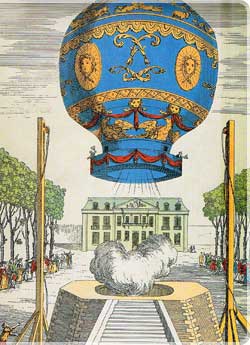
And so, the hot air balloon is the oldest, successful manned technology for flight! On November 21, 1783, the first manned and untethered flight was performed, carrying Jean Francois Pilatre de Rozier and Francois Laurent d'Arlandes into the air above Versailles, with King Louis XVI and Marie Antoinette watching along with everyone else. The balloon was built in December 1782 by the Montgolier Brothers, Joseph-Michel and Jacques-Etienne. The Montgolier family actually were paper manufacturers and their company still exists today.

The Chinese of ancient history actually utilized the concept of hot air to float lights in the air, about 250BC, and there were other attempts to lift small things, but nothing like an entire structure with passengers! The Montgolfiers first tried an unmanned flight, lasting 10 minutes, in September of 1783, a tethered manned flight achieved in October, but the climax was in November with the two men ascending, looking down on the crowd below, without a safety net, so to speak. Funny thing, but King Louis wanted to send a couple condemned criminals up for the test flight, but the idea soon sank, with de Rozier and d'Arlandes petitioning for the honor of being the first.

Take a look at the beauty of the scene:

 
By the way, the first military use of the balloon was at the battle of Fleurus in Europe, 1794, the aircraft being used for an observation post!

Friday, May 30, 2014

Green Cheese?

The other night I watched The Right Stuff, a great film based on Tom Wolfe's book of the same name. The account of the breaking of the sound barrier, allowing NASA to begin their astronaut program, which would eventually lead to the goal of going to the moon. The first seven astronauts were chosen, and one by one, sat atop a rocket to be pushed beyond the atmosphere into space. By today's technology, they sat in a tin can, hurtled off the top of a bomb, heading out with very little assurance that they would ever come back. Took special men for sure, men with "the right stuff".

Of course, the dream of understanding and exploring the heavens began in ancient times, but by the 18th Century, the telescope was being further and further sophisticated, giving a better and clearer picture of what's "out there". In 1704, Isaac Newton described a telescope in the published "Optick", but in 1720, John Hadley built the first really useful reflecting telescope. 
The early 1700's found mathematicians understanding gravitational pull of the Earth, Moon and planets. Here are some accomplishments: 
In 1700 Boyle, Lord of Orrery, invented a hard-driven model of the solar system
In 1719 Maraldi explained the changes of Mars polar caps as ice.
In 1757 Clairaut fixes the best ever mass of Moon and planets.
In 1763 Tobias Mayer published his "British Mariner's Guide" helping sailors fix location by the stars. 
In 1775 Mayer issues the first topographic map of the Moon!
In 1791 Banneker improves calculations of eclipses and the Moon's phases.

All this knowledge allowed us to eventually step foot on the Moon, realizing that it was not made of green cheese, but the stuff dreams are made of!

Friday, May 2, 2014

An Ounce of Prevention

The past couple days have been hell for me. The winds and pollen are up in the desert this time of year, and they can really wreck havoc on those prone to allergies. Basically, I don't like to take medicine, generally leaning to natural remedies if possible.

It got me to thinking about what people did in the 18th Century to cure colds, allergies, "maladies" as they are often referred to.  At that time, women of the household were in charge of making and dispensing remedies for common complaints, these being for the most part, herbal. Part of a young girl's education included learning recipes for these concoctions. Sometimes a remedy was just the drinking of hot wine made from elderberries, but often cures called for the making of a syrup, or an herbal tea, or lozenges produced then hardened into a candy. There is an interesting book called the Accomplish'd Gentlewoman's Companion, written in 1753, a cookbook by Eliza Smith, published in London, that records many of these homeopathic recipes.

Taken from "The Art of Cookery made Plain and Easy", here is a interesting recipe: "Take pearls, crab’s-eyes, red coral, white amber, burnt hartshorn, and oriental bezoar, of each half an ounce; the black tips of crabs-claws three ounces; make all into a paste, with a jelly of vipers, and roll it into little balls, which dry and keep for use."


By the way, "homeopathy" comes from the Greek, "homios" meaning "similar", and "pathos" meaning "suffering". Homeopathic remedies can be harmful if one doesn't take care. Herbs are not always easy on the system, though they can purge and thereby rid the body of toxins. The homeopathic cure was evolved by Dr. Samuel Hahnemann, a German physician, in the late 18th Century. He was appalled at medical practices of the times, and sought a better and safer way.  Basically the homeopathic way allows the body to heal itself.


"Dr. Hahnemann's classic example was when he took cinchona bark, he became ill and his symptoms mimicked that of malaria. This means that the bark of the cinchona tree which can cure malaria when prescribed to a person inflicted with malaria can actually produced malaria symptoms when given to a healthy person. He continued to experiment and he eventually established the fundamental principles of the science and art of homeopathic cure - "let likes be treated by likes" and he treated the sick based on this principle."
Below see a list of remedies by category:

An infusion: A liquid made by soaking an herb – usually its dried leaves or flowers – in liquid. An herbal tea is really an infusion.
A decoction: A liquid made by boiling an herb.
A poultice: A soft, moist mass of bread, meal, herbs, etc. applied to the body.
A plaister: A solid or semi solid remedy, spread on cloth or leather and applied to the body.
An electuary: Powder dried herb and mix with three times as much honey.
An oil: Fresh or dried herb is soaked in oil to extract the essences of the herb. Usually applied externally.
An ointment: Fresh or dried herb is soaked in lard to extract the essences of the herb, then mixed with beeswax and turpentine. Applied externally.

Friday, April 4, 2014

The Great White

I began reading Moby Dick last week. It was a gift to me, and having finished a number of other stories, I started this classic. I try each year to tackle one of the great classics. I say "tackle" because they are usually large, detailed, ponderous in fact. (think of Dickens works). When you start one, you must be up for the challenge, but when you finish, you know why they endure. They speak to us universally. The characters may be dressed or speak differently today, but everyone knows these people. The ambitious Becky Sharp, the analytical Sherlock Holmes, the honorable Jean Valjean, the obsessive Captain Ahab!

 
Yes, Ahab is obsessed with catching up with the whale who took off his leg, but of course, the story goes much deeper than that. But, in beginning my reading, the story makes mention of how does one classify the Whale...animal or fish? And then a particular paragraph mentions Carl Lenneaus, and his classification system of taxonomy, published 1735. As he uncovered more and more information, later editions were published. Known as the Systema Naturae, it was rather revolutionary for its time.

Linneaus sites the whale as a mammal, in the CETE classification. He states, "Animals that suckle their young by means of lactiferous teats. In external and internal structure they resemble man: most of them are quadrupeds; and with man, their natural enemy, inhabit the surface of the Earth. The largest, though fewest in number, inhabit the ocean."

His Mammalian Characteristics include
  • Heart: 2 auricles, 2 ventricles. Warm, dark red blood
  • Lungs: respires alternately
  • Jaw: incombent, covered. Teeth usually within
  • Teats: lactiferous
  • Organs of Sense: tongue, nostrils, eyes, ears, & papillae of the skin
  • Covering: hair, which is scanty in warm climates, hardly any on aquatics
  • Supports: 4 feet, except in aquatics; and in most a tail. Walks on the Earth & Speaks
His Cete Characteristics include
  • Fins: pectoral instead of feet
  • Tail: horizontal, flattened
  • Claws: none
  • Hair: none
  • Teeth: in some cartilaginous, in some bony
  • Nostrils: none, instead of which is a fistulous opening in the anterior and upper part of the head
  • Food: mollusca & fish
  • Habitation: the ocean
Linneaus goes on to include the different types of cete, including narwhals, dolphins, porpoise, various whales and then the great sperm whale (The Great White), the largest and the object of Captain Ahab's obsession.
This is what I like about a good book. It makes you want to know more, and as they say, the more you know, the less you know.