Showing posts with label Dance. Show all posts

Friday, February 19, 2016

A New Kind of Swan

Last night I watched a wonderful program, PBS's Independent Lens, which featured a documentary about Misty Copeland, ABT's, (American Ballet Theatre's) principal ballerina, crowned  on June 30, 2015. But the most striking thing about her coronation is that Misty the first African American woman to be promoted to principal dancer in ABT's 75-year history.
It's quite an achievement when you think that the most compelling image we generally have of the ballerina is the White Swan from Swan Lake. And, indeed, the ABT and every major ballet company in history has thought that until now!
How lovely to see that someone can be acknowledged on their merit rather than their race, or nationality, or particular look. I find it so inspiring, as the ballet has always been close to my heart.


When I was little, my Mom took me to start lessons, as this was her passion from a little girl, and with that love of the art in mind, she took me to see what it was like. Though I loved it in general, I was too scared, too shy to try. I was about 5 or 6, and I cried my way out of it. Understanding me, she did not say you must, and so we left. It was not until much later, that I tried again, more as a form of exercise, and I found it a wonderful, ethereal experience, but now I was too old to pursue it seriously. And so, watching Misty last night, I thought I would look at Ballet in the 18th Century.

Of course, Ballet is a type of performance art that originated in the Italian Renaissance court in the 15th Century, with technique and a vocabulary all its own based in French. But by the 18th Century, the ballet had moved from the royal court to the Paris Opera, with the director Lully preserving the form, but moving it forward to a much larger spectacle with choreography and costuming that liberated the dancer. This also was the point in time (no pun intended) that pointework came into fashion: Wearing the heel-less shoe, with the box toe that you could stand on, known as the demi-pointe.

The mid-18th Century dancer Marie Camargo of the Paris Opera Ballet was the first to hear these shoes, making her able to leap and twirl like never before. Eventually after the French Revolution, the shoe further evolved into the shoe we know today, secured by ribbons and incorporating pleats under the toes to enable dancers to fully extend their feet. It's truly a beautiful and graceful look. But it is not without cost, and I don't mean dollars. Years of physical abuse do take toll on the foot's shape. But I think every ballerina would say it's worth it.

Interestingly enough, the first dancers to get up on toe did so with an invention designed by Charles Didelot in 1795. His "flying machine" pointe shoes helped lift dancers up with on their toes before leaving the ground. The look was so airy that choreographers started looking for more ways to employ the technique in the performances.

By the way, my Mom kept her old "flying machines" and one day gave them to my daughter to keep, because she too loves the ballet.

Friday, February 13, 2015

My 2nd Annual Regency Ball!

It occurred to me that I have not had the opportunity to tell you about my attendance at the annual Regency Ball in Pasadena, California. Of course, part of the fun is the sewing up of an outfit to wear, and then learning the particular dance steps to English Country dances. The ball is better known as the Jane Austen Evening, and it is just one of this type of ventures into the world of Austen's literary works. You step back into time, with your outfit, the music played by an authentic chamber ensemble, the punch bowl, the fans fluttering, the dance card, and the general ambiance. People take these events rather seriously, but if you make a dance-step error, most people are not tremendously offended. There are some snobs, but most people go to have fun, to pretend they are Mr. Darcy, or Elizabeth Bennett (no matter what their age).

Last year was my first time out, and I made a traditional "Austen"-type empire gown. This year, I paid homage to Admiral Lord Nelson, by sewing up a Spencer jacket that had a military, or rather, Royal Navy, feel to it. I enjoyed making it, though now that I completed it and wore it, I see I could have done more. Isn't that always the way?! Nevertheless, it was fun to be there again, and I look forward to the chance to sew again, to design and embellish another Regency ensemble.

Meanwhile, I thought I'd mention a bit about the English Royal Navy uniform from that period. Of course, the officers wore the blue frock wool coat, with various degrees of gold braiding and buttons, depending on rank. There was the white shirt with neck tie, white vest and breeches. White hose, and black plain pumps. I wore my black flats, too, as you can see below. Sometimes the pumps were adorned with gold buckle. And, of course my favorite part is the black tricorne hat. Makes quite a statement.

Though mostly worn by military men, Catherine the Great was fond of the hat as well. I think I should have included one just to shake up the snobs! Ha Ha!


Tuesday, January 13, 2015

The Regency Era

At the end of this month, I am attending a Regency Ball in California. I attended last year, and it was quite an eye-opener, what with the costuming and attitudes of all the participants. Some were friendly and engaging, but some were haughty and foppish. Dance cards were filled out prior to the dance, and so if you did not do that, or were not approached, you were relegated to the "wall", unless someone happened by, or you were bold enough to get up and find a partner yourself. I am much more prepared this year. And, frankly, I'm all about the outfit. If I don't dance, I will not be put out. I will just remember to take my flask, and find another wallflower willing to toast one up! (I don't know if that's quite the etiquette of the Regency folk, but I'm not going to worry about it).
So, meanwhile, I am sewing away. This year I decided on an homage to Nelson's navy, and am designing a Spencer jacket that looks like a naval officer's coat. Lots of gold braiding on a midnight blue field.

I got to thinking about the word "regency". People of this English County Dance ilk are more concerned with Jane Austen and Pride and Prejudice. But, really, what was the Regency period?! 

Well, for those who don't already know, it is the years between 1811 and 1820 when King George III was deemed unfit to rule and his son, the Prince of Wales ruled as regent in his place. When King George died in 1820, the prince became King George IV and continued on. But the idea of a regency is fraught with problems. When the child or young person is not ready to rule, then a regency or council of others "help" his or her get the job done. There is a lot of vying for position or favor, and there is "power behind the throne" that does not always have the country in mind. Sometimes the Regency refers to 1795-1837, the latter part of George III's reign, when he was still king but watched over. He was diagnosed with porphyria (a blood disease), and had some periods of lack of clarity and lucidity. 

The Regency era, socially, focused on distinctive trends of style for British literature, fashion, culture. Elegance and achievements in fine arts and architecture were everywhere. Of course, there was war with Napoleon, that eventually gained Admiral Lord Horatio Nelson tremendous fame with his winning of the Battle of the Nile and Trafalgar! There was sort of a mini-Renaissance, and great patrons helped with the building of the exotic Brighton Pavilion (at left), and the refurbishing of other fine public works. Pride and Prejudice was published in 1813, and the early steam engine was developed. Quaker prison reformer Elizabeth Fry started her work at Newgate Prison. As you can see there were many things on many fronts going on. 

Friday, June 27, 2014

Keep on your toes!

Recently I purchased the most adorable pair of Summer flats. I couldn't resist them as I noticed a pair of ballet pointe style slippers on the department store display. All pink, with box toes and crossed ankle straps. Awww...reminding me of my days in the ballet studio. I love ballet, and the pointe shoe is the ultimate goal of all ballerinas. And so, even though I swore I was only window-shopping that day, I left the store with shopping bag in hand.

I looked up the history of the pointe shoe and found the following:
Women began dancing ballet in 1681, with the founding of the Academie Royale de Danse during King Louis XIV' reign. The shoes had heels at that time, but by the 18th Century, Marie Camargo of the Paris Opera Ballet wore the first flats, allowing her to perform leaps that would have been impossible in the shoes of the day. Her shoes were secured with ribbons at the ankles, and they incorporated pleats under the toes to be able to execute turns and extend the feet more fully.  In 1795, Charles Didelot invented the shoe that allowed dancers to STAND on their toes before leaping up. These light and airy leaps helped achieve a more ethereal look. Audiences loved it! Choreographers looked for more and more opportunities for their dancers to fly!

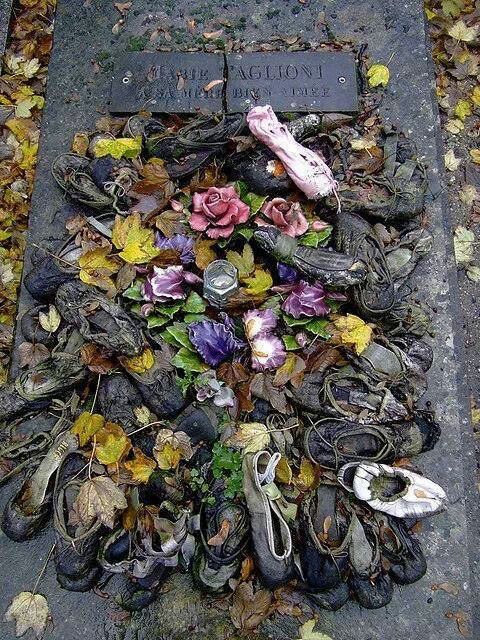
The true pointe shoe developed in later years through the 19th Century, with ballerina Marie Taglioni dancing La Sylphide en pointe, and the rest is history. Taglioni's grave is an homage to the dance with ballerinas leaving toe shoes at the site. It's the mecca of ballet dance.
Today, the pointe shoe sole is constructed of a single piece of leather attached to the shoe with special glue, and stitched along the edges for reinforcement. The toe box is a hard, enclosed area that holds the dancer's toes, with the front end of the box flattened so the dancer can balance and spin on a little flat surface. Often, dancers score the bottom of the shoe with a knife (if they are not scored already) to provide traction, and less slippage.

Of course, there is a tremendous price to pay for all that flight! Most dancers have damaged feet. It's very hard to continue to put pressure and weight on such a small area without eventual, detrimental effect. But, nonetheless, if you ask a ballerina to "be careful, don't spend so much time en pointe, take care of your feet", you might as well be talking to the wall. The dance is a magnificent obsession!