Showing posts with label Art. Show all posts

Tuesday, July 28, 2015

"Museum-Quality" Doodles!

The other day, I saw an interesting bit in the internet about Michelangelo and his market list! We think we are the only ones that doodle in the corners of our note pads, or pieces of paper we carry about to remind us of what to accomplish.
Of course, more and more people now enter these items in their Iphone apps, but the charm of individual or eccentric artistry goes by the wayside!

Whether Michelangelo sent his list with a servant, or went to the marketplace square by himself, this list is really a kick. He draws in a fish, fennel soup, a bottle of wine, etc etc. Perhaps the servant was illiterate. This would be a good way to guide him with the purchases. The list is archived at a museum in Florence, the Casa Buonarroti, along with other of his handwritten notes.


By the 18th Century, we have Thomas Jefferson, maybe not doodling, but keeping handwritten lists of the mundane.  Shown here at right are lists of vegetables and fruits sold from 1801-1809 from his garden. He was an avid gardener, and collector, who kept records of a wide variety of plants in his garden, but also the vegetables in the market in Washington DC, charting the first and last days the vegetables were available!  


And then there was Wolfgang Mozart, who did doodle on his letters! One example, above, is a drawing of his cousin Basle. 

Friday, July 17, 2015

Bobbin Weave!

With a pending trip to the Normandy area in France, I am starting to research some of the local color, so to speak, and found that in Bayeux, lace making has been a big deal for centuries. These wonderful traditions of handiwork, if not passed on to new generations, will soon be gone, the way of so many beautiful, artistic endeavors. But, the citizens of Bayeux are doing something about that, giving classes to locals, and selling their finished product to visitors! Yay!

By the way, Bayeux is a small town in northwest France, established during the Roman Empire as Augustodurum (durum meaning Gate) about 4 miles from the coast of the English Channel. It later took the name of a 
Celtic  tribe, Bodicassi (meaning Blond Locks).

But the lace making is the thing to remember! Lace originated in Venice in the 1300's, but by the mid 1600's, any lace not made in France was prohibited in France, and so French artisans really stepped up their game, in order to compete on the world stage.

Lace was made to adorn the fronts of gowns, called engageantes. Sleeve ruffles were called quills. Lace was used for aprons as well as head caps. This delicate lace was created  with either a needle or bobbins. Bobbin lace is created by weaving linen threads separated by weighed bobbins around pins stuck in a pattern on a little circular pillow. Pins are removed as sections develop, and then the pins are reinserted to a new portion. Sometimes, between 80 and 200 bobbins have to be manipulated to create the most intricate patterns!

After the French Revolution, and the banning of ruffles in 1794, production really fell off. Can you imagine a law banning ruffles!! But, the town of Alencon continued to produce its noted lace. Good thing for us!

Tuesday, March 3, 2015

The Bayeux Tapestry

Recently I have become interested in doing some needlepoint work. It has been a long time since I have put thread to canvas; it's enjoyable, but patient work. There are no shortcuts, if you want to have something beautiful and long-lasting when it is finished.
I have been doing some reading on the Battle of Hastings, and had an Aha! moment. Why not reproduce the Bayeux Tapestry?! Well, at least some scenes from it. The original is about 70 meters long! Time will tell if I take this on, but right now, it sounds tempting.

The tapestry depicts the events leading up to the Norman conquest of England, involving William, Duke of Orange (The Conqueror), and Harold, Earl of Wessex, later King of England. The climax is the Battle of Hastings. The tapestry chronicals the whole event, and is considered the supreme achievement of the Norman Romanesque period. It survives almost totally intact. It was embroidered with wool - all natural dyed colors, on linen. Along with the scenes are Latin titles. Probably produced in 1070 or there about. Its first reference was in 1476 when it was listed as inventory at the Bayeux Cathedral, in Norman France, and survived the sack of that city in 1562. But then, it was probably put away.

As far as the 18th Century is concerned, in 1724 there is reference to it when Antoine Lancelot sent a report to the  Acadeie Royale des Inscriptions et Belles-Lettres about a sketch he had received about a work concerning William the Conqueror. He did not know if the sketch was of a sculpture or painting. Later on, a Benedictine scholar found more information, finding that the sketch was from a tapestry! In 1729 the scholar, Bernard de Montfaucon, published drawings and detailed information about the complete work, still at the Bayeux Cathedral.

During the French Revolution, 1792, the tapestry was confiscated as public property and used, of all things, to cover military wagons!!!Thank God, it was rescued by a local lawyer, storing it at his home, until the fighting was over. The Fine Arts Commission, after the Reign of Terror, helped to safeguard it as a national treasure. It was moved to Paris for display at the Musee Napoleon, but when Napoleon abandoned his invasion of Britian, in 1803, the work of art was again taken back to Bayeux where it remains today.


Wednesday, September 24, 2014

Back from the Big Apple

Home now after a wonderful vacation, I am back with some stories from my trip back east. I will be blogging a bit about some eighteenth century things I saw while back in New York City, and in Boston.


Today, I write about the 9/11 Museum at the One World Trade Tower Center in Manhattan. The new tower is quite magnificent, if only one, but the grounds surrounding show where the original two towers stood, with their enormous fountains that are a memorial to those who lost their lives that terrible day. I can't say the museum's artifacts are exciting to see, nor do they elicit the same response as when we go to a museum and see beautiful objects. Rather, they serve as a remembrance of the horror, the utter destruction. Since everything was virtually disintegrated, there are only some personal artifacts, which are sad to see, i.e. someone's wallet, another person's shoe, a note pad with appointments, etc. Then there are the enormous girders, foundation walls, elevator engines, etc that almost look like gruesome sculptural pieces. It's something to see, but perhaps just once.


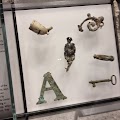
But! among the excavations for constructing the new building, workers found some interesting Colonial artifacts from early New York. Most of lower Manhattan was built over a landfill. These artifacts pre-date the Revolutionary War, unearthed in 2006. One of them a clay pipe bowl, another a key, a letter "A", and a tiny minute man figure. It's fascinating to imagine who they might have belonged to.
As time will permit, I will highlight some other finds from my trip, but for now, I am drowning at the desk!


Monday, August 4, 2014

Belle


Recently I saw the movie "Belle" based on the true account of Dido Elizabeth Belle, daughter of a West Indian slave, and Captain John Lindsay, British naval officer. Dido's mother died, and John, who spent most of his time on the high seas for the Royal British Navy, placed his child in the hands of his Aunt and Uncle back in England.  His uncle was William Murray, 1st Earl of Mansfield, who brought up Dido as a free gentlewoman, who lived with them for 30 years. Her father, upon his death, left her with an annuity of several hundred pounds, which actually made her a rich woman for the times, and an independent one as well.

In the movie, of course, artist license is used, with Dido given a better place within the household, than in real life. Though it did not detract from the story, in reality, Dido kind of assumed a role as a lady's companion, taking dictation for the Earl's letters, managing the dairy and poultry yards on the estate. She was given an annual allowance of £30, several times the wage of a domestic servant.

Not only was she illegitimate, but also her race played a role in her adult life. She was truly never quite accepted as an equal, but there is an interesting twist to the story. The Earl's family had a gallery of paintings of family members and ancestors, and one of the paintings depicts Dido along with another young family member, quite equally honored and depicted of equal status. Today it hangs in Scone Palace in Scotland.
Eventually Dido was married John Davinier in 1793, a Frenchman who worked as a gentlemen's steward, and she had three sons.

The painting was painted in 1779, of Dido and her cousin Elizabeth Murray, the Earl's niece, attributed to Johann Zoffany, a German neo-classic painter.