Showing posts with label Founding Fathers. Show all posts

Tuesday, March 1, 2016

What's in a Name?!

Recently we have been appalled, or at least should be, at the lengths to which negative campaigning has gained momentum in this year's political campaigns, especially on the Grand Old Party's side. It's been likened to school yard bullying, with juvenile name-calling, i.e. big ears, sweating like a pig, peeing in his pants, and on and on. You would think we are trying to elect six-year-olds. Being a long-time conservative, I am beyond saddened.

But I looked into the name-calling phenomenon, and actually it goes way back, and it was just as ugly, though we have the benefit of social media and television to further it along. Monarchies have been bashed, but out own country, going as far back as Washington's time, the mudslinging was on full display, and the political elite were not beyond calling poor old John Adams, "His Rotundity". Today, we'd call that fat-shaming.  

IN 1796 Alexander Hamilton, under the pen name "Phocion" (he didn't even use his real name), attacked Thomas Jefferson on the pages of the Gazette of the United States, a prominent Philadelphia Federalist-leaning newspaper. He resorted to the dirty politics of personal behavior, claiming that Jefferson was having an affair with one of his slaves. (Of course, it was true), but he went on to say that Jefferson was a "coward" and that "Mr. Hamilton was a pillar of virtue". Ahhh, remember bid Bill Clinton and his time under the Oval Office desk!

Adams said if Jefferson was elected, the country would descend into civil war, with the freeing of the slaves, and the implication that Jefferson was an atheist. Adams said Jefferson's supporters were “cut-throats who walk in rags and sleep amid filth and vermin.” Jefferson liked the personal, physical trait insult, calling Adams “old, querulous, bald, blind, crippled, toothless Adams.” Geez...these were men we have immortalized as statesmen!

By Andrew Jackson's election, a bit later on, handbills accused Jackson of being a cannibal after the massacre of 500 Indians, “the blood thirsty Jackson began again to show his cannibal propensities, by ordering his Bowman to dress a dozen of these Indian bodies for his breakfast, which he devoured without leaving even a fragment.”

Don't get me wrong, it doesn't make any excuse for today's bad behavior. You would think we have gone beyond these tactics, but I guess not. That's why it's so easy to see why folks choose to stay home on election day, but that's not good either. It's our right, our privilege , our duty to have our say. We may not like the choice, but we do have it, even if we have to resort to writing in a name on our election day ballot!

Friday, February 5, 2016

May the Best Man (Woman) Win!

There's a lot of whoopla going what with the upcoming election, and selection of candidates. It's something that has evolved over time into the "circus" that it has become today.

By contrast, here is a bit of a time line for the first US election of a President:

  • July 2, 1788: New Hampshire notified the Continental Congress that it  ratified the constitution. Congress then began making decisions about the formation of a new government.
  • By September 1788: Continental Congress approved a timeline to install the government.
  • In December 1788 to January 1789: Election too k place for an electorate.
  • On January 7, 1789: Electors pledged to George Washington were elected through the nation.
  • In February 1789: The Presidential Electors met in  various states  to cast their electoral vote
  • On February 8, 1789: Messengers left their various states to present their certificates of vote to be read by the first Congress
  • By March 4, 1789: This was the Appointed day to have state votes read in Congress. But, neither the House nor the Senate had a quorum.
  • On March 4, 1789: This was to be the original Inauguration day, but, the electoral votes had not yet been counted, only eight of the 22 Senators and 18 of the 59 Representatives  were present.
  • On April 5, 1789: First day marked a quorum to count the electoral votes. Washington won the Presidency with a unanimous vote,  and John Adams was elected Vice President
  • On April 6, 1789: The Senate ratified the election; a quorum assembles in both houses and a joint session of Congress took place to count the votes.
  • On April 30, 1789: George Washington was inaugurated as the first President of the United States in New York City, the nation’s capital at that time.

Simple by contrast to today's elections, but there was some dissention to be noted as time began to pass, and candidates realized the importance of the office and the politics involved. In 1796, the Presidential election was Contested!
Washington had had two terms, and chose not to run again (which was possible then). He actually set the stage for the nation's first two party election! This election would test the system, and whether the government was by, of and for the people, in actuality.

Two main contenders for the office campaigned vigorously, establishing a political battle that would last through the next election of 1800. Two main issues were views on constitutional government and foreign policy. The French Revolution had its say within the United States, with John Adams and his party, the Federalists, supporting the Jay Treaty. Thomas Jefferson and the "anti-Federalists" who would later be the conservatives, opposed the treaty because it favored the British.The Federalist did not want to support the French because they did not want another costly war with Britain. The Jeffersonian party on the other hand felt that it was the duty of the United States to support the French because of the French assistance during the American Revolution.

The bulk of  campaigning took place in the newspapers. Adams had won the election by only 3 votes and Thomas Jefferson, who finished second, automatically became vice-president.The election of 1796 had exposed an inherent flaw in the Electoral College System. The Electors voted on one ballot with two names on it. The candidate, who had the most votes, won the election. The candidate who had the second most votes became the vice president. 

Can you imagine if that occurred today? Imagine if Trump won and Hilary became VP; or She won, and Cruz was her Veep, or Sanders won and Rubio was the 2nd man!? Or what if someone is drafted at the Conventions.....how about Joe Biden and Jeb Bush?

Seriously, though, perhaps it's not a bad idea after all. They would be forced to work together, across the aisle as they say!  


Friday, July 24, 2015

Indiana Jones, 18th Century Style

Recently, (I don't know what possessed me), but I got out my DVD series of the wonderful Indiana Jones saga.  I started looking at Raiders of the Lost Ark, and soon I was hooked. I have now watched them all, and looking at the "bonus" disc of the making of each of the films. It really is an addictive thing. For those interested, there is an actual site, indianajones.com that of course, promotes the sale of all the films, but also has information about archeology in the 1930's, Indy's bio, the villains, etc. etc.

As we know, archaeology is the study of human activity through the ages, primarily focused on recovering artifacts, cultural data, human remains, religious practices, architecture, and analyzing the findings, not only for their place in history  at the time but as a benchmark as it relates to other time periods. We get to understand peoples of a different age, but how they relate to the people we are today. 

I looked into the history of archaeology, especially through the 18th century, and can report the following:
The antiquarian movement of the 17th Century gave rise to a nationalistic endeavor to turn private collections over to museums for the general public's education and pleasure. By the way, antiquarians were those interested in personal collections of artifacts and curios, usually kept in their homes, libraries filled with bones, fossils, or shards of pottery  from ancient civilizations. One could play the "scientist" and boast a bit about their particular collection to those who were invited to view!  


People were hired by museums to go out and look for collections, and entice the owners to give up their personal treasures for the greater good, and perhaps with their name attached to the particular museum gallery in which they were to be displayed. One man, Giovanni Battista Belzoni, was hired by Henry Salt, British consul to Egypt, to gather antiquities for England from far away lands. London, of course, to this day, has one of the greatest collections of Egyptian antiquities in the world.

The father of archaeological excavation is William Cunnington, who lived from 1754-1810.  He undertook excavations in Wiltshire, England around 1798, along. His work was funded by a number of patrons.  

Cunnington's terms for categorizing archaeological finds are still used today. He kept meticulous records of Neolithic and Bronze Age barrows. The first use of a trowel as an excavation tool are sited in a letter Cunnington wrote to one of his wealthy patrons, Richard Colt Hoare, in 1808.

A casual aside: One of the Freemason's tools is the trowel, symbolic of  "the more noble purpose of spreading the cement of brotherly love and affection, that cement which unites us into one sacred band or society of friends, among whom no contention should ever exist, but that noble contention, or rather emulation, of who can best work and best agree."
The Masonic ideal was very popular in the 18th century. Among some of the notables were Founding Fathers George Washington, musician Mozart was a mason. Alexander I Zsar of Russia, poet Robert Burns, naval hero John Paul Jones, and
Madame de Xaintrailles, Republican heroine of the French Revolution.


Tuesday, July 14, 2015

Happy Bastille Day!

A friend reminded me that today is Bastille Day, and so Happy Bastille Day! Today marks the 225th anniversary of the storming of the Bastille prison on July 14, 1789, marking the culmination in Paris of the violent revolution that begun in 1797, and the unity of the French people against the monarchy. 

By order of the new government, the prison was torn down. On February 6, 1790 the last stone of the hated fortress was presented to the National Assembly. Not too long after, the 14th of July was made the official national holiday.

And by the way, the key to the prison was entrusted by French General Marquis de Lafayette to Thomas Paine, to give to General George Washington as a symbol of solidarity and friendship. The key, to this day, hangs in the entryway hall of Mount Vernon!

Thursday, May 7, 2015

Get a Room!

On May 7th, 1789 President George Washington attended a ball in his honor, which became the model for the official inaugural ball, held for Madison ten years later! From Madison's inaugural to the present day, this celebration has become tradition, though I'm sure it was not the media event it has become today.

Washington took the oath of office on April 30, 1789, then the special ball was held a week later in New York, as it was the temporary seat of the US federal government. The event was located in a building on Broadway near Wall Street. Martha, his wife, could not attend as she was packing up things at Mt. Vernon before she left for "the Big Apple". Can you imagine that kind of thing happening today. The "little woman" at home attending to domestic chores?!

Anyway, George arrived along with some other statesmen and their wives, and even danced a couple dances! It is said he liked to dance, was graceful, didn't step on anyone's toes, and held up a good conversation. It is said he liked the minuet! Vice President John Adams and family were there as were some French and Spanish dignitaries. Eliza Hamilton, Alexander Hamilton's wife, recorded some of her impressions in a memoir.
John Adams and Thomas Jefferson had their official parties, too, but still sedate, and dignified as was befitting the office. By 1809, Dolly Madison threw a huge gala for James Madison, her husband. 400 people in attendance at Long's Hotel in Washington DC. She, being her flamboyant self, got the ball rolling so to speak for the events we now witness. Bigger, grander, more celebrity-attended, more "can you top this"! And we can look forward to this now every four years.

And having been to one, I can speak from experience. Even though it now occurs in January, and the weather is generally extremely cold, no one is bundled up against the wind and/or snow. Shoulders are bared, cleavages exposed in deep V-neck gowns, lots of foundation, powder and lip liner, and yes, a great deal of botox. Men and women's faces, as the evening goes on, are flushed with excitement, fueled with cocktails.
People talk to one person, while looking over their shoulder to see if they are missing anything or anyone better to attack with copious qualities of charm and influence. It's quite a spectacle. And actually, the President and Mrs. must attend more than one ball. They make the rounds, have a chat, an official dance and then they're off to the next. And now days, we have the overt PDA. Get a room!

 What would the founding fathers think if they were a fly on the wall?!

Wednesday, December 17, 2014

Take this Capsule, and call me in two hundred years!

Last week a time capsule dating back to 1795 was unearthed from the granite cornerstone of Massachusetts Statehouse! How exciting! Historians believe it was placed there by Samuel Adams and Paul Revere, and perhaps some of their contemporaries.

It has not been opened yet, but it is believed that it contains some coins and newspapers, but it is in precarious condition and Secretary of State William Galvin thinks some of the items may have deteriorated over time. It will go to the Boston Museum of Fine Arts for x-raying, then be opened.

It is in the shape of a box, made of cowhide, and it is thought that it was placed when the statehouse was being built. John Adams was governor of Massachusetts at the time.

Actually, the time capsule was removed in the 19th Century, and it contents transferred to a copper box. So, it means that the box was known about, and removed recently due to an ongoing water filtration project at the building. It will be returned to its cornerstone location when the project is complete.

Museum conservator Pamela Hatchfield says that the box is heavy, and enthusiasm is high for the discovery of its contents. Another time capsule from 1901 was recently found, uncovered from the Old State House, the state's first seat of government, and contained some well-preserved newspaper clippings, a book on foreign policy and some letters from journalists of the time.

Time will tell what is found inside the Statehouse box!

Monday, December 15, 2014

A Mount Vernon Favorite

George and Martha Washington welcomed thousands of guests to their estate Mount Vernon, They were noted for their boundless hospitality, frequent parties, and for the culinary treats served.

One interesting dish was the Salamongundy is a late-seventeenth-century term for what is actually a dish salad. Composed of a variety of ingredients ranging from greens, herbs, cucumbers, edible flowers, and lemons to roast chicken, anchovies, and other meat or fish, it was suitable for a lovely buffet in a gracious home such as Mount Vernon.

Vegetables of quality were a prized addition to any table, and Mount Vernon features a lovely garden of its own from which the Washington's kitchen staff could choose from.

Below is a recipe from Mount Vernon, that you might like to try.

Ingredients

2 heads romaine lettuce, cored and thinly sliced crosswise
1 roasted chicken (about 3 pounds), carved into breasts, wings, and legs
10 to 12 anchovies
1 lemon, diced
4 yolks of hardboiled large eggs, minced
1 bunch fresh parsley, stemmed and chopped
1/2 pound small white onions (can use pearl onions), cooked and peeled
Salt
Ground black pepper
Blanched red grapes for garnish
Blanched young green beans or haricots verts for garnish
Nasturtium blossoms for garnish
A light dressing of lemon and olive oil
  

Tuesday, December 2, 2014

Cheers to George!

With the Christmas holiday on its way, I look for interesting and tasty gifts for my whisky drinkers, yet I'd have to go to Mount Vernon to pick up these particular bottles. That's the caveat.... no shipping. You must be present to pick up your purchases. Sorry, guys.
Anyway, this is quite a special whiskey - from George Washington's Mount Vernon estate!


In Washington’s time, whiskey was not aged and was sold in its original clear form. George Washington’s Rye Whiskey® is the most authentic version of Washington’s whiskey available today, at $185/bottle. Mount Vernon staff used Washington’s original mash bill and traditional 18th-century methods in the production of this rye whiskey. The mash bill, or recipe, was discovered by researchers examining the distillery ledgers for 1798 and 1799. His whiskey consisted of 60% rye, 35% corn and 5% malted barley.

The Rye Whiskey was made according to Washington's original recipe then aged on-site in charred oak barrels for two years. Mount Vernon staff produced this whiskey based on traditional 18th-century methods. After aging for two years in barrels, this straight rye whiskey was bottled and labeled by hand, at $95 each.

Cheers!

Friday, August 8, 2014

Ancient Technologies for Today!

I just finished watching a wonderful lecture series about Greek and Roman technologies from the catapult to the Pantheon. It was fascinating, not only to hear about ancient buildings and machinery, but to see their employ in modern application. The course instructor is Dr. Stephen Reseller, a professor at West Point Academy. He makes the subject come alive. His enthusiasm is contagious.


The last lecture shows how very much alive all these ancient methods are in modern or near modern history. One building caught my eye, as it was produced in the 18th Century, that of Monticello, the home of Thomas Jefferson, which he designed and built. He was a bit of a Renaissance man, with interests in science, art, architecture, politics, history. After the fussiness and over-the-top decor of the Baroque era, it was time to scrape away the icing on the cake, and get to the heart of the matter. Hence there was a revival of the classical era design, now called Neo Classical, a getting back to basics, as it were. Monticello, placed side by side with Rome's famed Pantheon gives an interesting picture of classical themes brought to life once again. Note the colonnaded entry, the triangular tympanum over the pediment and the domed section of roof.
 
Jefferson designed and built his home in 1772, located in Albermarle County, near Charlottesville, Virginia. He studied the works of the ancients for inspiration. He used contemporary materials, including the bricks typical of the Federal style which had become so popular in Colonial America, but the walls and proportions reflect the order of the original ancient building.
That's why classics are classics; why they are timeless. Good taste lasts forever!

Monday, July 7, 2014

Up, Up and Away!

Over the weekend, I watched the wonderful HBO mini-series, John Adams. The story of the American Revolution is exciting and moving, and the character portrayals in the series are so vivid. You really get the sense that these were real people, with all their good and bad points, strengths, weaknesses, hopes and desires.

One of the scenes that caught my attention was the one in which Thomas Jefferson, Abigale and John Adams watch the ascent of a hot air balloon, joined by commoners and court members dressed in silks and satins, powdered wigs. Jefferson looks filled with hope; Adams is typically skeptical. The musical score, composed by Joseph Vitarelli, truly sets the tone of the scene. We are transported, we ascend as well. It's time to not only marvel along with the observers at this great event, but to get out the Kleenex box! Things will never be the same!
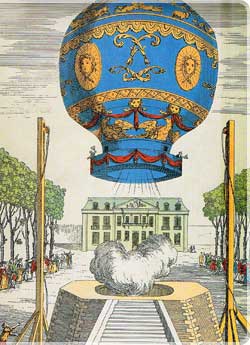
And so, the hot air balloon is the oldest, successful manned technology for flight! On November 21, 1783, the first manned and untethered flight was performed, carrying Jean Francois Pilatre de Rozier and Francois Laurent d'Arlandes into the air above Versailles, with King Louis XVI and Marie Antoinette watching along with everyone else. The balloon was built in December 1782 by the Montgolier Brothers, Joseph-Michel and Jacques-Etienne. The Montgolier family actually were paper manufacturers and their company still exists today.

The Chinese of ancient history actually utilized the concept of hot air to float lights in the air, about 250BC, and there were other attempts to lift small things, but nothing like an entire structure with passengers! The Montgolfiers first tried an unmanned flight, lasting 10 minutes, in September of 1783, a tethered manned flight achieved in October, but the climax was in November with the two men ascending, looking down on the crowd below, without a safety net, so to speak. Funny thing, but King Louis wanted to send a couple condemned criminals up for the test flight, but the idea soon sank, with de Rozier and d'Arlandes petitioning for the honor of being the first.

Take a look at the beauty of the scene:

 
By the way, the first military use of the balloon was at the battle of Fleurus in Europe, 1794, the aircraft being used for an observation post!

Wednesday, May 28, 2014

Old Nevada


I just returned from a few days out of town, to explore old mining towns in Nevada. It was an adventurous, good time. Nevada, by the way, comes from the Spanish meaning "snow covered"! And, us Nevadans don't like the state's name pronounced with a "soft" A. We like the "hard" A like in "BAD".
I wanted to blog about the area, about 2-1/2 hours (depending how you drive, ha ha) north of Las Vegas, up US 95 Highway.   

There is not much history documented about Nevada before 1861, but I did find a few "nuggets" of information that might be of interest. As we know, Native Americans of various tribes roamed the land of the region, but it was Francisco Garces, who became the first European in the area. Garces was a Spanish Franciscan friar, a missionary and explorer. He lived from 1738 - 1781, exploring much of the Southwest. He is even credited with giving the Colorado River its name. He was eventually murdered along with his companion friars during an uprising of the Indians, and has been declared a martyr for the Catholic faith.

The area of Nevada became part of the Commandancy General of the Provincias Internas, part of the Alta California, or Upper California province in 1804, when the Californias were split. Nevada was annexed as part of the Spanish Empire, in what became known as New Spain.

The US was eager to expand into the Southwest to develop farms and settlements, with the national government initially seeking to purchase Native American land by treaties, though the settlers did not like the idea. The US policy toward the Natives continued to evolve after the American Revolution. George Washington believed that they were equals, but that their society was inferior, so he developed a policy to encourage the "civilizing" process. His six point plan included:
 
1. impartial justice toward Native Americans
2. regulated buying of Native American lands
3. promotion of commerce
4. promotion of experiments to civilize or improve Native American society
5. presidential authority to give presents
6. punishing those who violated Native American rights.


And so, here is a little bit about 18th Century Nevada. Actually, there is a lot of fascinating information about the state during the mid 1800's with the mining boom, the Comstock load, in Virginia City and later in the Tonopah and Goldfield area in 1905. Check it out sometime. Those stories are "golden".

Monday, May 19, 2014

Bowled Over!

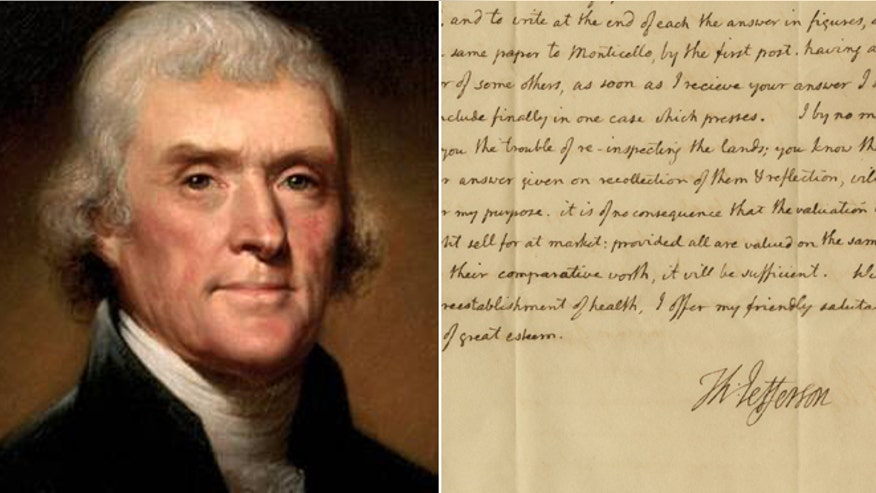
Last week there appeared a news item that I found interesting. I love Thomas Jefferson, and when I saw his name in the headline, I had to see what it was all about.
Apparently, a dealer of historic documents was selling a letter Jefferson wrote in 1805, all for the nominal price of $35,000!
It was a letter that Jefferson, president at the time, wrote to a friend, his estate manager, discussing the president's desire to have his forest of poplar trees appraised. The poplars were planted at his Virginia plantation. He was 62 at the time, and looking to portion off portions of his property to his grandchildren. It is a glimpse of Jefferson as a family man, concerned about the future, when he is gone.
jefferson3.jpg

It is a one-page, handwritten document that belonged to an anonymous collector, and now Raab Collection of Philadelphia will conduct the sale. Perhaps the anonymous collector is disposing of his property too.
Let's hope a museum purchases the letter, so perhaps we can enjoy seeing it occasionally. It's interesting to see one's handwriting, to analyze its characters, allowing us an insight into the man. Did he write it carefully? Was he in a hurry? Did he scratch out a word or two? (Remember, there was no wite-out then). Did he use correct punctuation, word spelling? From the fragment of the letter above, it looks like he was a careful writer.
Below, is a picture of a poplar at Monticello. Quite large, isn't it? I wonder if it was there when he built his estate, or if he planted the young tree near his windows? Well, it is quite spectacular now.
Above right is another view of the Monticello estate. You can see the plantation as it moves into the distance. And also pictured above is an example of a bowl made from poplar wood that is sold at the Monticello estate gift shop. Each one is different, and beautiful. I think I'd rather have the bowl than the letter. The artist is Frederick Williamson, and you can see how he cuts out pieces of fallen poplars, and then sets to work. At about $350 a bowl, I think it might be easier to spring for!!