Showing posts with label Culinary. Show all posts

Thursday, December 10, 2015

A Holiday Treat!

We are well into December now, and thinking of holiday parties and festivities to come. At every Christmas gathering, there are the traditional dishes, some based on where one lives around the  globe, and some based on tradition, mostly German and English, like the "Dickens Christmas", for instance.

In 1773, noted English clergyman James Woodforde, was asked to organize a holiday meal at New College, Oxford, and of course, he included Mince Pies! Below is his recipe, that was recorded in 1795.


Parson Woodforde’s Mince Pies

For the mincemeat (2-2 ½ lbs):
¾ lb cooking apples;
8 oz currants;
8 oz raisins;
6 oz shredded suet;
8 oz dark brown muscovado sugar;
4 oz lean beef mince;
grated rind and juice of 1 medium lemon;
1/8 teaspoon ground mace;
1/8 teaspoon ground cloves;
1-2 drops cider vinegar to sharpen (optional);
3-4 dessertspoons brandy, to taste.
Peel and core the apples. Mince them, together with the dried fruit and suet. Then mix in all the other ingredients. Store in airtight, vinegar-proof pots in the refrigerator. Use within three weeks.
For the mince pies (about 20):
Do not use the mincemeat uncooked. Grease bun or patty tins and line with puff pastry. Fill with the mincemeat; the quantity above should fill twenty deep 2½ inch diameter tins. Cover if you wish, but remember that fatty meat may float off a little free during cooking; it can be blotted off open tartlets after cooking. If not covered, top each mince pie with a rosette of brandy butter before serving. 


By the way, Woodforde is the author of The Diary of a Country Parson. It is a rather detailed and meticulous record of his life. It provides an authentic look at the life of country life in England at the time. You might find it a tasty treat as well!

Monday, August 10, 2015

A Scandinavian Delight!

This morning, I saw an recipe about an 18th century bread bun. The picture looked great, and I thought what a nice breakfast that would make along with a lovely cup of rich, dark coffee. Let's put away the "politically-correct", "gluten free", "healthy" breakfast, and talk about the Semla, or Selmor, Bun! Yumm!
Originally only eaten  on Shrove Tuesday, the day preceding Ash Wednesday, before Lent, the Semla bun is a Scandinavian delight, a Swedish bread that came served in a bowl of warm milk. Today they are found in Scandinavian bakeries shortly after Christmas until Easter.   

The Semla is cardamom-spiced bread with an almond paste and cream filling. They have been eaten in Sweden ever since the 18th Century, and warning: King Aldolph Frederick died in 1771 after eating 14 of them! Of course, he had a rich dinner to start. Perhaps the Semla was the straw that broke the camel's back!

The bread takes about 2 hours to make. The ingredients are as follows, and make about 15-20 of them:
2 cups almond paste
¾ cup plus ½ quart heavy cream 7 tablespoons butter 1 ½ cups milk 3 cups flour One 1.4-ounce package fresh yeast ½ cup sugar 1 egg, beaten 2 teaspoon salt 1 tablespoon ground cardamom 2 egg yolks 1 teaspoon water Powdered sugar, for dusting

Melt butter in a pan, add milk and heat until lukewarm. Mix cardamom, sugar, salt, yeast and most of flour in a large bowl. Make a well in the centre and add the milk mixture and egg. Knead dough for five minutes till sticky. Cover and leave to rise 30–40 mins.

Knead dough on a lightly floured surface until smooth. Make into balls. Place on  trays lined with parchment paper; leave to rise for 30–40 mins. 
Preheat oven to 400o. Bake buns in lower part of the oven for 20–25 mins till browned.

Once cool, slice off the top of each bun and set aside. Fork out a layer of crumbs and reserve them in a bowl. Grate the almond paste and combine with the crumbs and milk. Blend into a thick paste and fill each bun. Whip cream till stiff and place onto the almond paste. Put back bun tops and dust with icing sugar. 

Wednesday, July 22, 2015

A Pie is not always a pasty!

I have been watching the new PBS series, Poldark, set in the 18th Century. The leading character, Russ Poldark, is from Cornwall, England.  After fighting in the American Revolutionary War, with General Cornwallis' defeat,  the British soldiers return home, Poldark, among them, only to find his father dead, their lands left unkempt, and their copper mine abandoned. Russ picks up the mantle, and tries to make a go of it. It's a good story, based on a series of novels by British author Winston Greene (1908 – 2003). (He also wrote Marnie in 1961, later turned into the Alfred Hitchcock film).

Cornwall is noted for its tin and copper mines, producing the majority of the UK's production of these metals until very recently. So, mining was the thing in the region, hence the story revolves around the importance to the success or failure of the area residents.

And, now for the best part! The Cornish pasty! During the 17th and 18th centuries the pasty became popular with the workers in Cornwall, the miners adopting it as the food of choice for their daily fare. It had a unique shape, forming a complete meal that could be carried easily and eaten without forks or knives. In the mines,  the pasty's dense, folded pastry would stay warm for several hours, and if it did get cold it could easily be warmed on a shovel over a candle flame!

The side-crimped edge gave rise to the thought that the miner might have eaten the pasty holding the thick edge of pastry, which was later thrown away,  ensuring that his dirty fingers  did not touch food or his mouth. There was fear of intake of arsenic. This may or may not be true, but I don't believe poor folk would throw away any food.

The recipe for the Cornish pasty, includes diced or minced beef, onion, potato and swede (a turnip type vegetable) in rough chunks seasoned lightly with pepper and salt. The cut of beef used is usually skirt steak. Sometimes carrots are included, but generally frowned upon in Cornwall. Baked in shortcut barley flour pastry 'til golden brown, they make a hearty meal.  

There is a belief that the pastry on a good pasty should be strong enough to withstand a drop down a mine shaft! By the way, the pasty recipe and its traditional "D" shape have a protected status. A meat pie may not always be a pasty!

Thursday, April 2, 2015

An Easter Tradition

With Easter just upon us, I looked into 18th Century traditions, and found the following:

The "Easter Bunny", or Osterhase, is a product of 18th Century Germany, one of the ages greatest pleasures for the children. Children would decorate brightly colored nests in quiet areas of the house. The Oster Hase would lay eggs in it for them, if they were good! Eventually the nest became a basket, and has been used ever since, not really for eggs, but for candy and small Spring-themed gifts.

My favorite tradition is the baking of the Hot Cross Buns. Since medieval times, marking bread with a cross was a common thing to do, warding off evil spirits that could affect the bread, making it not rise, or go moldy. A round bun was formed, and the cross divided it into 4 lunar quarters. These were known as Good Friday or Cross buns, but the first written reference to "Hot Cross Buns" came in 1733.  

These buns are sweet and spiced, and include currants or raisins, and traditionally eaten in the UK, Ireland, Australia, New Zealand, the Caribbean, South Africa, India and Canada. The sun never sets on the Hot Cross Bun!

Wednesday, February 11, 2015

Venturing into the World of Baking Bread


Recently I decided that this year's new venture should be bread baking! I started last weekend with a recipe for brioche. It's a wonderful bread, and for a first attempt, it came out tasty, though it did not raise up into anything glorious. So, I will try again. Meanwhile, I will tell you about brioche and the 18th Century:

The first use of the word, on record, is from France in 1404. It was featured in Cotgrave's "A Dictionarie of the French and English Tongues" in 1611, indicating a Norman origin. In the 17th Century, it was introduced as "pate a tarte brioche" as a lighter and cheaper version of blessed bread, the bread used for communion.

In the 18th Century, however, the bread became richer, tastier as more butter and milk were added. The blessed bread was replaced by the brioche we know. The great butter markets of Gisors and Gournay played a role here, promoting the use of their product. And, butter is the secret to good brioche!

It is documented that "Gisors, on market days, they produce up to 250 or 300 kg of brioches. The dough is made the evening before (1 kg of farine, a quarter of which for the starter, 10 g of yeast, 7 or 8 eggs; one mixes this together with the starter and 800 g of butter, breaking up the dough, which 'uses up the butter'. The dough is kept in a terrine, and one puts it in a mold just at the moment of baking. Thus prepared, the brioche remains light, keeps well, maintains the flavour of butter, without the stench of the starter. Brioche of varying degrees of richness from the rich man's with a flour to butter ratio of 3:2 to the cheaper pain brioché with a ratio of 4:1 existed at the same time."

In his autobiography "Confessions" published 1782, Jean-Jacques Rousseau tells the story of a great princess said to have advised the peasants, the poor folk, who had no bread, to "Qu'ils mangent de la brioche", or "let them eat cake". This translation is inaccurate, but none-the-less, the princess was referring to giving out the cheaper brioche. It was still an expense as there were 40,000 parishes in the kingdom where blessed bread was distributed.

Thursday, January 8, 2015

Comfort and Joy!

Happy New Year! 

We are well on the way into January, but there is still time to celebrate it a bit. When friends came to see in 2015 with me, upon their departure, I gave them a small bag of black eye peas to take home with them. It is a bit of a tradition in our family, but not ours alone. As long as I can remember, my Mom made black eye peas after New Year's Day. It is supposed to guarantee a year of adundance!

I looked into this, and find the following:
These peas, which are actually a bean, originated in Africa in ancient times. They only came to America in the 1700's along with the slave trade. Mostly used in the South in Florida and the Carolinas, they became a staple and were used in stews with greens and ham hocks as an inexpensive flavor booster.

There are many recipes but the traditional is best, first soaking the beans, then putting them in water with salt, peppper, a ham hock, and a squeeze of lemon. Let them simmer til softened, but not too soft. You don't want mush.

They are a friendly food, and if they don't bring wealth, they will certainly bring comfort and joy! 

Monday, December 15, 2014

A Mount Vernon Favorite

George and Martha Washington welcomed thousands of guests to their estate Mount Vernon, They were noted for their boundless hospitality, frequent parties, and for the culinary treats served.

One interesting dish was the Salamongundy is a late-seventeenth-century term for what is actually a dish salad. Composed of a variety of ingredients ranging from greens, herbs, cucumbers, edible flowers, and lemons to roast chicken, anchovies, and other meat or fish, it was suitable for a lovely buffet in a gracious home such as Mount Vernon.

Vegetables of quality were a prized addition to any table, and Mount Vernon features a lovely garden of its own from which the Washington's kitchen staff could choose from.

Below is a recipe from Mount Vernon, that you might like to try.

Ingredients

2 heads romaine lettuce, cored and thinly sliced crosswise
1 roasted chicken (about 3 pounds), carved into breasts, wings, and legs
10 to 12 anchovies
1 lemon, diced
4 yolks of hardboiled large eggs, minced
1 bunch fresh parsley, stemmed and chopped
1/2 pound small white onions (can use pearl onions), cooked and peeled
Salt
Ground black pepper
Blanched red grapes for garnish
Blanched young green beans or haricots verts for garnish
Nasturtium blossoms for garnish
A light dressing of lemon and olive oil
  

Monday, November 3, 2014

The King of Flour


With the holidays coming up sooner than we think, a lot of us will be heading to the pantry for our baking supplies....for those traditional cookies and cakes. We all have our favorites that we like to enjoy in our own homes, as well as distribute to family and friends. BUT, the most important aspect of this baking is the ingredients we use!!
That being said, I turn to flour. By and large, one is only as good as one's ingredients, and it's important to use the very best. The king of flours is, of course, King Arthur Flour, a brand established in 1790!

King Arthur Flour is the oldest flour company in the US, founded in Boston in 1790, providing high-quality flour for the colonists. Henry Wood started importing European flour, primarily English milled flour, to the Long Wharf in Boston, his goal to supply the best for bakers in America. He called the company by his name, later gaining stock holders and revising the name to Sands, Taylor & Wood Company, which included another Wood (George Wood - no relation to Henry). More than 100 years later, the company name was changed to King Arthur, introducing the product at the Boston Food Fair.

In 1896 George Wood attended the theatre to see a musical, entitled King Arthur and the Knights of the Round Table! This was his inspiration for the name change! Perhaps he liked the idea of the knights sitting around a common table supping bread and wine! Who knows, but nevertheless, we are the better for it.

Wednesday, July 30, 2014

Bakers Ingredients

Just as today, 18th Century bakers put a lot of importance on the type of ingredients they used for their bread recipes. Specific sources for water were identified, including water from rivers, fountains, wells or the collection of rain. Bakers from Gonesse, France said that rain water was best for its particular natural properties. Gonesse is in the northeastern suburbs of France, home of cuisine extraordinaire, about 10 miles from Paris. So, they ought to know!


These bakers said that you must use the "lightest of water, because it works itself better into the clumps of flour mixed with the leaven. Rain water makes the dough ferment and rise, because it is lighter than that of fountains or rivers." Now, I don't know about that, but in the 1700's, I guess it made sense.


Yeast, in those days, was always "brewer's yeast", which is a type of fungus (saccharomyces cervisiae), used to brew beer as well as bake some particular breads. This yeast was considered "artificial", as opposed to "old dough" that you actually reserved a portion of fully developed dough before shaping loaves of bread, and retaining it in a covered container to use in the next batch, and then the next. This is a starter, as it were, somewhat like the starters used in sour dough bread, where some portion is reserved for the next time one decides to bake.

Of course, many 18th Century bakers used beer in exchange for water in recipes. The 1771 Encyclopedia Britannica includes the following technique for bread making:
“The meal, ground and bolted, is put into a trough, and to every bushel are poured in about three pints of warm ale, with barm and salt to season it: this is kneaded well together with the hands through the brake; or for want thereof, with the feet, through a cloth; after which, having lain an hour to swell, it is moulded into manchets, which scorched in the middle, and pricked at the top, to give room to rise, are baked in the oven by a gentle fire.”

By the way, the Celts are rumored to have introduced beer into their dough for an airier loaf. This goes back to the Iron Age.


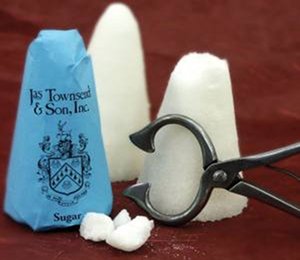
Another important baking ingredient is sugar, which was extremely expensive at the time, often called "white gold". In the 18th Century it was a product of the development of thousands of sugar plantations in South, Central and North America, giving rise to the African slave trade with over 12 million slaves shipped to various locations around the globe. The "sugarloaf" was the traditional form in which the refined sugar was distributed and sold until cubes were introduced in the 19th Century. A tall cone with rounded top was the shape, achieved when, at final boiling (for refining), the sugar was poured into large conical molds of earthenware or iron. The dark, molasses based sugar drained through the bottom of the mold, leaving the white to remain. When cool, the cones were wrapped in paper, and sold. To use, one had to chip away the sugar from the cone with tongs.


As they say, it's the quality of the ingredients that make for the best cuisine!


Tuesday, May 20, 2014

Let Them Eat Brioche!

As the weather has changed, and it's beautiful in the desert now, I have been enjoying breakfast on my balcony. This early morning experience is a joy to me, a celebration of the day to come, a relaxing treat before the storm of the business day begins. The hummingbirds come to my ever-so-close feeder. I hear their wings (I guess) clicking, and I look up and there they are! And what to serve? I try to make it lovely, with French-press coffee, fresh fruit and some kind of special bread perhaps.  
Sunday, I decided it was time to make brioche! It has been forever since I made the wonderful French delight, all warm out of the oven, smeared with butter and Bonne Maman jam! Yumm! And so, I set to work. It was not difficult, but time consuming, so in between steps, I did other things, including laundry, reading, more laundry, catching some Lydia's Italy on PBS.

Yesterday I enjoyed a warm slice of it out in my little Paradise. And I decided to do some research as well. Brioche goes way back, to the 1400's,and it is a Norman bread. It derives its name from Old French "brier" meaning "to work the dough with a "broye" or "brie", a wooden roller for kneading.  

The bread developed along with the introduction of butter, eggs and sugar, becoming more and more expensive to make. Originally known as a pain benit or blessed bread, it became kind of a delicacy with the expensive ingredients, and by the 18th Century, it was enjoyed by the wealthy. The more butter added, the more rich, literally and figuratively. Of course, anyone could make it, but usually adjustments to the proportion of butter were played with. The rich man used 3:2 flour to butter; the poor baker, 4:1.

In his autobiography, "Confessions", published 1782, Jean Jacque Rousseau (French writer and influential thinker) relates that "a great princess is said to have advised, with regard to peasants who had no bread, "Qu'ils mangent de la brioche", commonly inaccurately translated as "Let Them Eat Cake". 

The "great princess" is mis-attributed to Queen Marie Antoinette. In the contemporary "Encyclopedie" published at that time, it says,"the taste for luxury and onerous magnificence of much of the world, having slipped into religious practice, the usage was introduced in large cities of giving in place of bread, some more or less delicate cake ... one would not believe what it costs the nation every year for this article alone. We know that there are more than 40,000 parishes in the kingdom where they distribute blessed bread".
It's typical though to credit Marie with the callous remark, though she paid dearly for her lack of compassion. Got me to thinking......., the brioche often has a little head on it, a little round ball of dough formed and pressed into the top of the larger dough ball. It's fun to break that off and eat it first. Now I will always remember Marie's head!!!

Wednesday, March 19, 2014

Something to chew on!

I recently finished watching the Hornblower series. I'm quite sorry it's over now. They are great stories, and really well-portrayed. And so, I continue in my British naval history mode.

Today I was looking into some information on what captain, officers and crew ate when setting off to sea.

I found a very interesting account in a book by Janet MacDonald, Feeding Nelson's Navy, published 2006.A good deal of previous accounts show life at sea, as far as eating is concerned, tantamount to being in a severe prison, with stories of starvation and rotten food for crew, while the captain and his officers dined in unrepentant splendor. MacDonald begs to differ, having done some new and striking research.

She shows how the sailor diet could actually be better than what he might have ashore, and of better nutritional value as well. She remarks that the reason for the great mutinies of 1797, with food a major grievance, was more the abuse of
the system, not the food itself. But the system of distribution was a logistic marvel for the times. At the height of the Napoleonic Wars, the Royal Navy fed a fleet of over 100,000 men, in ships gone for months and months away from home.  

It was the British Navy that almost totally eradicated the dreadful disease of scurvy, by 1800. That's a major accomplishment in itself. The idea that citrus (limes in this case) had a profound healthy effect. We so know this today, downing copious qualities of Vitamin C at the drop of a Kleenex!!

Though there was no real preservation of food as we know today (refrigeration and canning), the Victualling Board was able to generally provide enough food to serve the needs, including the packing of meat, brewing of beer, and baking of biscuit.

Of course, once on board, these foods were strictly controlled and distributed as fairly as possible. And, she comments, that in many cases, captain and officers took lesser cuts of meat, and allowed crew to have the heartier. After all, they were the one's who needed the strength for hard labor.

Everyone got daily rations of beer to drink, as water in casks went bad very fast. And of course, there was the daily tot of rum, a treat for good behavior.

MacDonald points out that some captains kept gardens ashore along their assigned cruising lanes to supply the crews with vegetables.

This is not to say that life on board was easy or a romp in the park. Discipline was strict and swift, to keep the wooden world functioning properly, but new research gives the food issue some new information to chew on!  Makes me want to read MacDonald's book!

Thursday, February 28, 2013

Puddings on the High Seas!

Currently, I am reading Book #19 of 21 of the Master and Commander series, "The Hundred Days". As I have said before, it's a wonderful series of the adventures of Captain "Lucky Jack" Aubrey, his good friend Dr. Stephen Maturin (Irish activist, and spy for the British government...shhhh!), and the enduring crew of the Surprise. At the moment, political intrigue abounds regarding Napoleon Bonaparte ("Old Boney"). Is he still in power? Is he planning conflict on land as well as at sea? We will find out as the book unfolds.

But, meanwhile, daily life goes on for Aubrey and his mates, the continual daily washing of decks, the exercising the great guns, the Sunday church rigged with the reading of the Articles of War, etc etc. And, of course, there are accounts of Aubrey's famous dinners for the high-ranking officers of ships under his overall command. He is a Commodore now.

And this is where I spend some time with you today, to tell you about the wonderful if unusually-named desserts served out with the after-dinner port and cognacs at the Commodore's table. These desserts are prepared by his faithful cabin servant Killick, a crusty old crank of a man, whose claim to fame is keeping the Aubrey's uniform to as perfect a condition as possible, and polishing the silver serving platters to an incredible gleam.
Not an easy task given that he is responsible for all the Captain's meals, cooking and mending and cleaning all in a very tiny space, a closet really, just off the great cabin.

The first dessert, he has often prepared (a favorite of Aubrey), is the famed, or infamous-named, Spotted Dick (or Dog).  The recipe is as follows:
8 oz. flour, 1 pinch salt, 4 oz suet, 1 oz sugar, 8 oz currants or raisins, 150 ml cold water. Combine the flour, salt, sugar, suet and fruit. Mix into a dough with water. Form it into a ball, and put on a warm, damp cloth. Sprinkle with sugar. Roll up the dough and leave to expand in size a bit. Put into a pan of boiling water, cover and boil for 2 hours. Add more water if needed. Turn out onto a serving platter, and serve with custard sauce. Yumm!

The second: Plum Duff
This has a more cordial name, as it were. But, in looking at the definition, "duff" is also a slang word for buttocks. So, here goes the recipe: 2 large eggs, 1/2 c vegetable shortening, 1 c brown sugar, 2 c cooked prunes, 1 c flour, 1 tsp baking soda, 2 tbs cold milk. Beat eggs. dissolve sugar in hot, melted shortening. Add to eggs. Add cooked prunes after draining and mashing. Sift flour, and add. Dossolve soda in milk and add.
Fill greased pudding mold 2/3 full, cover and steam one hour. Serve with rum sauce. Very tasty, but may add to the general size of one's buttocks!

The third: Suet Pudding
Suet, as you may not know, is fat from beef or mutton. So, don't be shy, and give it a try! 1 c brown sugar, 3/4 c ground suet, 1 egg beaten, 1/2 c milk, 2 c flour, 1 tsp sode, 1 tsp cinnamon, 1 tsp nutmeg, 1 tsp salt, 1/2 c chopped walnuts, 1 c raisins cooked, cooled, drained.Mix sugar and suet. Stir in eggs, milk. Sift dry ingredients together and add. Stir til blended. Fold in nuts and raisins. Spoon into steamer pan or pudding mold. Put wax paper loosely over mold to prevent steam collecting on pudding. Steam 3 hours, remove and serve.

I can't decide which I like best, but if you were months at sea, probably eating alot of fish, or salted beef, I think any one of these desserts, or puddings as the English call most any dessert, would be a welcome ending to any meal, especially if served with the ports and cognacs, and some good music as well. Remember, Aubrey and Maturin are famous for their violin and cello offerings. Give a look below:

http://www.youtube.com/watch?v=qL9ahJBgbwI


Monday, April 30, 2012

Hard Tack: The Sailor's Saltine Cracker?

This weekend I decided to make some hard tack, in an effort to better understand the harsh diet that poor sailors of the 18th Century had to endure. Just one of the awful staples, though probably "wholesome" none-the-less, was hard tack. It is quite simple to make:

2 cups flour
1 cup water
pinch of salt (or use a cup of sea water if you find yourself out on the ocean!)

Combine the ingredients, knead the dough a bit, roll out thinly on a floured surface. Cut into squares or rounds. Prick with fork tines, and bake for about 25 minutes at 350o. Then let dry on a baking sheet. Actually, I rolled mine out on corn meal, just to be different. The recipe yields about two dozen.

Well, to say they are tasty would be a great lie. To say they are easy to eat...that would be another. To say they are basic food. Yes, I guess you could say that! (And they last FOREVER). I actually had a couple for breakfast this am, though I improved them with honey and some almond butter. I must say, they look nice (see below), but would I proudly serve them to friends and family? I should think not!!!

Wednesday, December 28, 2011

The Eyes Have It!

The Owlery is getting ready for New Year's, and my annual Seeing-In-The-New-Year party. I must say, I thoroughly enjoyed my "Williamsburg" Christmas, with handmade decorations, pomanders, gingerbread, cedar garlands, bay leaves, pinecones. The house still smells good. The holiday was more quiet and reflective, and a breath of fresh air. I am keeping all of the decor up until January 6 (Epiphany), but adding a bit of glitz to the scene in honor of 2012. I'm planning my menu, with small savory snacks, and more desserts, champagne and the Vasilopita (Greek New Year's/St. Basil's bread) to be cut at midnight with friends and family. Who will get the gold coin this year?!?!

One thing I will be serving is the traditional Black Eye Pea soup, always served on December 31st, as a good luck offering. I started looking up its history, and here goes:
The pea is small and pale beige with its black "eye", (a subspecies of the cowpea). It originally came from West Africa, later widely grown in Asia. It was first introduced into the Southern United States as early as the 17th Century, but took a firmer hold in Florida and the Carolinas during the 18th Century, and reached Virginia in full force following the American Revolution.

The soup, made with the peas, onions, carrots, salt, pepper, vegetable or chicken broth,  (and collard greens and ham, if you like Soul Food, Yumm!), is said to bring properity! Who doesn't want that?!

I have been soaking the peas since last evening, and will be making the soup tonight, to let it mellow a bit, flavors congeal, before serving. It is one of my favorite, tasty, hearty soups, and I say, "The eyes have it!"

Thursday, December 22, 2011

Love and Joy come to you, and a Merry Christmas, too!

Christmas is only a couple days away, and all the shopping and preparing should be done. Now it's time to celebrate our Lord's Nativity, with all the wonderful traditions that have been handed down to us, and to partake of those we have made our own.

It's time to lift a glass from the Wassailing Bowl, as did our Colonial forefathers, and toast family and friends! Of course, Wassail is an English tradition, but the American Colonials embraced it, too. "Wassail" comes from the Old Norse word "ves heil"and and the Old English "was hal" which means "good health". This is the greeting that goes along with the ritualized drinking and toasting at Christmastime.


The old Traditional song captures it best:

    Here we come a wassailing
                                                             Among the leaves so green.
And here we come a wand'ring
So fair to be seen.
Love and Joy come to you
And to you your wassailing too,
And God bless you and send you
A Happy New Year!

Hear a lovely, spirited version, for your enjoyment:

And, finally, see a recipe you can make for the great day:

Merry Christmas to All, and to all a Good Night!

(I will be gone a couple days over the holiday, but I will be accumulating stories to tell you.)


Monday, December 19, 2011

The Countdown!

With a little more than a week before Christmas, The Owlery is shaping up. I am getting a bit excited for my annual gathering, and sharing some of the holiday with friends. I am starting to gather up my baking for packaging. This morning I read a bit about the Twelfth Night Cake, which has its origins back to the Middle Ages, but really took hold by the 18th Century, with all the Christmas festivities and merriment. The cake was a sweet cake/bread, decorated beautifully, and within was hidden a bean or pea! Whoever got that piece with the bean was crowned the King or Queen of the party! I may very well institute this for my gathering as well.
I had mentioned that I am an Orthodox Christian, and follow our religious traditions as best I can. Similar to the Twelfth Night Cake, we have a sweet bread that we bring out to share with friends on January 1st, as we celebrate the New Year combined with St. Basil's Day. During his life in early Christian times, he brought gold coins to distribute to the poor. We bring out our Vasilopita (or St. Basil's Bread) at midnight, and cut it for those present as well as a piece for the house (which includes everyone, present or not).
In my home, I have a gold coin that goes into the cake, and whoever gets the coin keeps it for the coming year as a good luck charm. I recently recieved my coin back from its temporary caretaker for the year 2011, and it will now be baked into the 2012 installment! (That's the job my Mom has done for me for many a year now...part of the tradition). My coin has had many ventures out from The Owlery, and has graced mantles, and icon shelves and little particular places of honor in my friend's and family's homes. The Vasilopita is our type of Twelfth Night Cake! It just shows how traditions are passed down and around and made our own!

Tuesday, December 13, 2011

Can I offer you some "Water of Life", with some special ice?

My favorite alcoholic spirit is Scotch Whisky, and I'm not talking the casual blend, commercially found and copiously consumed without regard to the "Water of Life's" fine history, and myriad of tastes depending of the region of Scotland that they come from. Actually, "Scotch Whisky" is a protected term.
Historically, whisky comes from the Gaelic work "usquebaugh" which means "water of life", later shortened to "usky", and much later "whisky" in English. The production of whisky goes way back, in recorded exchequer rolls of the late 1490's, but reached a peak of untaxed production in the 18th Century. Clandestine stills were cleverly organized, and many varieties were distilled. Smuggling and avoiding the excisemen became a way of life for many in the Highlands.
(As an aside, the famed Scottish bard, Robert Burns, spent part of his life as an exciseman in the late 1700's.)
Unfortunately, by 1823, an Excise Act was passed and licensing fees were imposed, however, on the good side of the coin, this change lead to the foundation of the Scotch industry we know it today. There's always an upside, a looking at the glass half full, so to speak!
In the late 1700's, improved methods for farming barley led to the greater possibility of commerical production.
My personal favorites are single malts, and include:

The Balvenie Doublewood 12 year old - See their site, great information. http://www.thebalvenie.com/ Speyside, Scotland
The McCallum 12 Years - http://www.themacallan.com/home.aspx Speyside, Scotland
Caol Ila - from the Islay area
Glenmorangie - http://glenmorangie.com/ Rothshire area

All these distilleries have their founding after 1800, but the tradition and respect of the distillation keeps the historic perspective. Some are sweet, some are peaty, some smoky, some mellow and warm, but they all have their place when sipped alone, or paired with particular foods. This is not the whisky to "guzzle", but to savor. You can drink it neat (without ice), or with a bit of ice (a cube or two). I offer my own "special" ice of pure water, when serving to my guests.


And by the way, "WHISKY" comes from Scotland; "WHISKEY" is Irish or American. And, speaking of Americans, George Washington was producing his own whiskey at Mount Vernon in 1797. He established one of the largest distilleries in the country, with five copper stills, a storage cellar and an office. By 1799, when he died, the distillery produced more than 10,500 of rye whiskey and brandy, valued at $7,600, a very large sum at the time!

So, as the holidays approach, spread some cheer with some "water of life"! Slainte!

Friday, December 9, 2011

A Sweet, Decadent Treat!

The other night, in tribute to Mozart, I watched a bit of Amadeus. I have seen it "too many times", but still enjoy the performances, and looking closely at all the details...the costumes, the set design, etc. The other night I played close attention to the scene where Salieri first encounters Wolfgang, as Salieri spies on the musical genius from behind a fabulous dessert buffet, with all the incredible sweet offerings typical of court life in the 18th Century. The porcelain tureens, compotes with cherubs and harlequins and powdered wig darlings in all their splendor. Salieri is dazzled, too, but has to refrain as he hears Mozart's giggling approach. He crouches low, and must wait to partake.

And worth the wait! These desserts were not only beautiful, but very tasty, too.
And with Christmas approaching, I am inclined to try to replicate one, or more than one, if I get particularly ambitious. Just look at the wonderful 18th Century dessert poster at right. These delights were individual pieces stacked high, or molded in copper. Many desserts included fruit and other new delicacies brought from the New World, i.e. carambola, or "star fruit" as it is generally known.

A Christmas favorite is the croquembuche, the cream puff tower! It was invented by French chef Antoine Careme (1783-1833) in the late 1700's, initially as a wedding cake, but who wouldn't want to use any excuse to bring it on for other festive occasions, especially when you can grace the center of your holiday table with this glittering example of dessert extraordinare. The puffs are filled with pate choux, stacked and cemented with hardened sugar, spun around the tower.
Remarkable!

Another great, stackable, choice is the Sugar Plum sweetmeat. Various dried, sugared and slightly spiced fruit can be assembled, or whole slabs of Turkish delight can be cut in squares, dredged in powdered sugar and assembled at your whim.
You can also sculpt marzipan into little fruits, and paint with food coloring.

Also, don't forget about providing actual fruit, small pears, apricots, tangerines, or tiny apples on a lovely compote. There is no end to the possibilities!

And finally, courtesy of http://clickclackheels.blogspot.com/ I learned of a recent, Incredible (Incredible with a capital "I") runway show from the house of Chanel where the set design features a fantastic banquet, with the guests seated around an enormous glittering table, mermerizingly set with candles, crystal and silver, the models walking by sumptuous displays of delights. Perhaps the models ARE the dessert! So, the fantasy of the fabulous buffet table is still in vogue. Check it out!