Showing posts with label American Revolution. Show all posts

Thursday, March 10, 2016

A Worthy Woman!

This week has been International Women's Week. In this day and age, personally, I don't see the need, but I guess some women still want to make a point. Nevertheless, I did see an interesting article about the so-called "female Paul Revere". Her name: Sybil Ludington. She lived from 1761 to 1839, but her most proud moment was her evening ride of over 40 miles  (more than twice Paul Revere's journey) to warn her father's militia that British solders were coming!


This is how it went down: In 1777, Someone had come to warn the Ludington's of looting going on in Danbury, Connecticut. The 16 year old Sybil sprung into action, volunteering to rouse the scattered militia. She rode from 9pm that night until daybreak with a stick in hand to ward off bandits. Though the militia was too late to save the town of Danbury, they helped drive the British back to their ships. General Washington thanked her personally. In 1935, a statue was erected in her honor in Carmel, NY.

Tuesday, November 17, 2015

Showing Support!

With the hideous terrorist attacks in Paris, it is natural to want to show some kind of support for France and the Parisians. I was in Paris not too long ago, and the people were very friendly, helpful and showed support for the United States, especially in the Normandy area where D Day occurred.

People around the free world are flying the French tri-color flag along with their own. It's a beautiful sentiment.
I looked into another interesting, if not lovely, way to show alliance during the 18th Century. The "Cockade", or knot of ribbons, arranged in a circular shape and worn on the side of a man's tricorne hat, or on lapels or in the hair of women. The cockade would generally show, at that time, allegiance to some political faction, their rand, or as part of a servant's livery.

In pre-revolutionary France, the cockade of the Bourbons was all white. In Great Britian, supporters of the Jacobites wore them white, and in the Hanoverian monarchy, they were black.

In 1780, a blue cockade was worn as a symbol of anti-government feelings worn by rioters in the Gordon Riots.
During the American Revolution, the Continental army wore them in various colors, until General George Washington stated  
"As the Continental Army has unfortunately no uniforms, and consequently many inconveniences must arise from not being able to distinguish the commissioned officers from the privates, it is desired that some badge of distinction be immediately provided; for instance that the field officers may have red or pink colored cockades in their hats, the captains yellow or buff, and the subalterns green."


Eventually the Continental Army reverted to a black cockade that they inherited from the British. When France became a US ally, the Army pinned the white cockade of the French Ancien Regime onto the old black cockade. The French in turn pinned a black circle of ribbons to their white. These became known as the "Union Cockade". Later on, the French would develop the tri-color (red, white, blue - the arms of Paris) cockade, known as the "Tricolore".

And there you have it, the origins of a very pretty as well as powerful symbol of allegiance. Makes me want to sew one up right now!

Friday, August 21, 2015

Machete v. Mascara

On August 20, two women graduated from the US Army Ranger School. They leave their mark as a new generation of women in combat roles. They are the first to complete in their combat leadership course, one of the hardest challenges, both mentally and physically for anyone.
They have trained in combat situations, been deprived of food and sleep, and all the particular rigors of becoming a full-on Ranger. They were held to the same standards as the men, with no compromises. It is quite an achievement.
But they are actually not the first to participate in combat for their country. Just the first to complete this level of training, and as declared women. There have been others but they had to hide, be dressed as male soldiers, in the American Revolution or other conflicts, with a few of them enlisting in disguise.

Anne Bailey, known as Samuel Gay, acted as a frontier scout, serving in the Revolutionary War and the Northwest Indian War. In 1791, she made a famous ride through the frontier to find much-needed gun powder to help secure the endangered Clendenin Settlement, later known as Charleston, WV.

Deborah Sampson, at left,  served in the Continental Army during the Revolution, serving for 17 months under the name Robert Shurtliff, of Uxbridge, MA, She was wounded in 1782, and later honorable discharged at West Point in 1783.   

Then, there was Hannah Snell, at right, an English woman, who joined the British Marines after the death of her daughter. Her unit sailed to India to capture the French colony of Pondicherry. She fought in a battle in Devicotta in June of 1749. She was wounded 11 times, once to the groin, and asked a sympathetic Indian nurse not to reveal her identity during treatment. She was honorably discharged in 1750.

The magnitude and extent of today's Ranger training makes people sit up and take notice, but relatively speaking, the accomplishments and service of these 18th Century women was just as bold. Personally, I don't have the constitution or inclination to lift a 180+ man through a muddy jungle. Or shave back my tresses or get rid of my mascara. It's not for everyone, but for those who want that kind of thing, I say why not. Women have taken their place in all walks of life previously only designated for men. Just don't give me a US President named Hilary this coming election.

Friday, July 24, 2015

Indiana Jones, 18th Century Style

Recently, (I don't know what possessed me), but I got out my DVD series of the wonderful Indiana Jones saga.  I started looking at Raiders of the Lost Ark, and soon I was hooked. I have now watched them all, and looking at the "bonus" disc of the making of each of the films. It really is an addictive thing. For those interested, there is an actual site, indianajones.com that of course, promotes the sale of all the films, but also has information about archeology in the 1930's, Indy's bio, the villains, etc. etc.

As we know, archaeology is the study of human activity through the ages, primarily focused on recovering artifacts, cultural data, human remains, religious practices, architecture, and analyzing the findings, not only for their place in history  at the time but as a benchmark as it relates to other time periods. We get to understand peoples of a different age, but how they relate to the people we are today. 

I looked into the history of archaeology, especially through the 18th century, and can report the following:
The antiquarian movement of the 17th Century gave rise to a nationalistic endeavor to turn private collections over to museums for the general public's education and pleasure. By the way, antiquarians were those interested in personal collections of artifacts and curios, usually kept in their homes, libraries filled with bones, fossils, or shards of pottery  from ancient civilizations. One could play the "scientist" and boast a bit about their particular collection to those who were invited to view!  


People were hired by museums to go out and look for collections, and entice the owners to give up their personal treasures for the greater good, and perhaps with their name attached to the particular museum gallery in which they were to be displayed. One man, Giovanni Battista Belzoni, was hired by Henry Salt, British consul to Egypt, to gather antiquities for England from far away lands. London, of course, to this day, has one of the greatest collections of Egyptian antiquities in the world.

The father of archaeological excavation is William Cunnington, who lived from 1754-1810.  He undertook excavations in Wiltshire, England around 1798, along. His work was funded by a number of patrons.  

Cunnington's terms for categorizing archaeological finds are still used today. He kept meticulous records of Neolithic and Bronze Age barrows. The first use of a trowel as an excavation tool are sited in a letter Cunnington wrote to one of his wealthy patrons, Richard Colt Hoare, in 1808.

A casual aside: One of the Freemason's tools is the trowel, symbolic of  "the more noble purpose of spreading the cement of brotherly love and affection, that cement which unites us into one sacred band or society of friends, among whom no contention should ever exist, but that noble contention, or rather emulation, of who can best work and best agree."
The Masonic ideal was very popular in the 18th century. Among some of the notables were Founding Fathers George Washington, musician Mozart was a mason. Alexander I Zsar of Russia, poet Robert Burns, naval hero John Paul Jones, and
Madame de Xaintrailles, Republican heroine of the French Revolution.


Tuesday, July 14, 2015

Happy Bastille Day!

A friend reminded me that today is Bastille Day, and so Happy Bastille Day! Today marks the 225th anniversary of the storming of the Bastille prison on July 14, 1789, marking the culmination in Paris of the violent revolution that begun in 1797, and the unity of the French people against the monarchy. 

By order of the new government, the prison was torn down. On February 6, 1790 the last stone of the hated fortress was presented to the National Assembly. Not too long after, the 14th of July was made the official national holiday.

And by the way, the key to the prison was entrusted by French General Marquis de Lafayette to Thomas Paine, to give to General George Washington as a symbol of solidarity and friendship. The key, to this day, hangs in the entryway hall of Mount Vernon!

Wednesday, July 8, 2015

Cur non?


Recently I saw a wonderful report about the frigate "Hermoine", an exact reproduction of General Marquis de Lafayette's 18th Century ship that he brought to America to fight along side General Washington in the Revolutionary War (1780). The project was started about 20 years ago, a group of folks deciding to try to reconstruction this very famous ship.

It's taken a long time (beginning in 1997), and a lot of money, I'm sure, but today the work is completed! It is the most authentically built tallship in 150 years! It set sail from France recently in April of this year, with a destination to the United states for this Summer 2015!

The journey started from the River Charente in Port des Barques where General Lafayette originally came aboard in March 1780, a 38-day passage, arriving in Boston. He reported to Gen. Washington, and played a major role in the victory achieved on October 19, 1781.


This new crossing to the US has taken a little under a month. On July 6th, the event culminated in the ship's arrival in Greenport's harbor, Long Island, NY, in time to be a part of the four-day Tall Ship festival! You can imagine what a magnificent site!


The Marquis' motto was "Cur non", or "Why not?" Why not, indeed! Nothing really great is accomplished without taking the big chance! And this endeavor was truly worth the effort. Not only exciting to see Hermoine sail again, but the preservation of history is the most important aspect of the reconstruction!

Wednesday, July 1, 2015

The Evolution of the Holiday!

The 4th of July holiday is only days away, with its festive Red, White and Blue décor, themed pies and cakes, and the Capitol Fourth TV program. Of course, there will be the Buy One, Get one Half Off Big Blow Out sales, and fireworks when darkness descends.
But let's look at the beginnings of the celebration:

In 1777, thirteen gunshots were fired in salute, once at morning and once again as evening fell, on the 4th in Bristol, Rhode Island. Philadelphia celebrated the first time in a manner a modern American would find quite familiar: an official dinner for the Continental Congress, toasts,  a 13 gun salute, speeches, prayers, music, parades, troop reviews, and fireworks. Ships were decked with red, white, and blue bunting in the harbor.

In 1778, General George Washington marked July 4 with a double ration of rum  for his soldiers and an artillery salute . Across the Atlantic Ocean,  John Adams and Ban Franklin held a dinner for their fellow Americans in Paris, France.

In 1779, July 4 fell on a Sunday. The holiday was celebrated on Monday, July 5.

In 1781 the Massachusetts General Court  became the first state legislature to recognize July 4 as a state celebration.

In 1783, Moravians in Salem, NC held a celebration of July 4 with a challenging music program assembled titled "The Psalm of Joy." This is recognized as the first recorded celebration and is still celebrated there today.

In 1791 the first recorded use of the name "Independence Day" occurred.

In 1870, the US Congress made Independence Day an unpaid holiday for federal employees.

In 1938, Congress changed Independence Day to a paid federal holiday.

And from this time forward, the holiday has become more and more commercial. Everyone puts on the Red, White and blue, but do they truly recall the holidays meaning. When you celebrate this year, give that some thought! Once upon a time, a lot of folks paid dearly for us to enjoy our freedom today!

Tuesday, May 19, 2015

Looking for the Comforts of Home

Recently my Mom gave me a bunch of letters from my Uncle, who was killed in  WWII, a Bombardier who perished over Bremen, Germany in August 1944. I never knew him, and these are a treasure, being introduced to someone who I have always heard good things about, but through his letters to his mother, I see the character of the person, the selflessness, the concern for his family, the responsibility and duty to his nation not only accepted but seen as an honor. He wrote practically every day from the time he left for training in late 1943 to the day before he died.

Got me to thinking about letters from 18th Century soldiers to their families and friends. My WWII letters are somewhat browned with age, but still in pretty good shape. Letters from over 200 years ago may be a different thing. Of course, letters written by famous commanders such as Gen. Washington survive and are displayed in museums and archives, but every day folk's correspondence is not always easy to find, or was kept in the best way possible.

As technology keeps changing, we are losing more and more hand written correspondence. Tweets, emails, etc have taken the place of what is generally and sarcastically known as "snail mail". But, to me, the an actual letter delivered to your mail box suggests that someone took the time to communicate, to choose the stationary, to write in detail, to (and this many be the most important!) choose their words most carefully. Once words are committed to paper, and placed in the mail slot, they are irretrievable. You better have been careful! 

For our purposes from the Enlightened Age, here's a sampling the American Revolution, from 1777:

Lieutenant WILLIAM BARTON of the Fourth and later the First New Jersey Regiment;To his father, Gilbert Barton of Allentown, N.J.,
(Whitemarsh, 22 November 1777) "...I expected to have been at home before this, but cannot Obtain leave Untill we go into Quarters, I have sent some clothes by Mr. Griggs which is one pair of Breaches two Jackets three pr Stockings...l am removed from the company I was in which was Capt. Lyon's and am know in Capt. Holmes Compy. as first Lieut, there are many officers resigning which is Like to make a Great deal of Promotion...my love to my Mother Sisters & all inquiring frinds..."


And, another from 1778 from Barton again, mentioning Valley Forge:

..."Camp Valley Forge, Feb. 18th 1778...I should wrote oftener but have been in expectation of Coming home but this day find my expectations blasted, and have no maner of hope to get home Untill April...I have Received my Coat & boots by Capt. Weycoff and am Inform'd you have procured me some shirts which I am Extremely Glad of as l shall be in Great need of them in a short time. I'me at this Present time in health, and hope these may find you all in Perfect health, if to the reverse at any time Please to give me inteligence Thireof and I shall come home at all Events. I have not Receiv'd a Letter from you since at home, should be very Glad to be favour'd with a few lines if Convenient and Likewise a few pounds of Sugar and A little Chocolate...there is a Scarcety of those articles in this Place...Camp does not very well agree with me..."


In the letters I am currently reading and copying, I see the every day life of an air man, a bombardier, in this case, asking for his Mom to send some heavy wool knit socks, or hoping she'll send some paper (as it was rationed), so he could write home. He also asked for some chocolate or gum to hand out.  In Lt. Barton's letter, you see him ask for stockings, some sugar, or chocolate. Not much has changed when looking for the comforts of home!

Wednesday, December 17, 2014

Take this Capsule, and call me in two hundred years!

Last week a time capsule dating back to 1795 was unearthed from the granite cornerstone of Massachusetts Statehouse! How exciting! Historians believe it was placed there by Samuel Adams and Paul Revere, and perhaps some of their contemporaries.

It has not been opened yet, but it is believed that it contains some coins and newspapers, but it is in precarious condition and Secretary of State William Galvin thinks some of the items may have deteriorated over time. It will go to the Boston Museum of Fine Arts for x-raying, then be opened.

It is in the shape of a box, made of cowhide, and it is thought that it was placed when the statehouse was being built. John Adams was governor of Massachusetts at the time.

Actually, the time capsule was removed in the 19th Century, and it contents transferred to a copper box. So, it means that the box was known about, and removed recently due to an ongoing water filtration project at the building. It will be returned to its cornerstone location when the project is complete.

Museum conservator Pamela Hatchfield says that the box is heavy, and enthusiasm is high for the discovery of its contents. Another time capsule from 1901 was recently found, uncovered from the Old State House, the state's first seat of government, and contained some well-preserved newspaper clippings, a book on foreign policy and some letters from journalists of the time.

Time will tell what is found inside the Statehouse box!

Tuesday, December 9, 2014

The Spy Trade

Last week there was an announcement of the new James Bond film, to come out in 2015, entitled Spectre! It's very exciting to anticipate another film about the famous spy! The past two films with Daniel Craig in the title role, have been particularly good. He and his fellow actors from the last film will be working together again to bring romance, intrigue and suspense to the silver screen once more.

Got me to thinking about spies of the 18th Century. Spying is a murky business that actually kick-started Britian's industrial revolution. For example, the town of Derby tried but was unsuccessful in competing with Italy for silk production. And so, John Lombe, Englishman, travelled to Piedmont, Italy to gain knowledge of how silk was spun there. He surreptitiously made drawings of the Italian machinery and smuggled them back to England. On his return he arranged for an engineer to construct a five-story building to use as a factory to wind, spin and twist silk! The factory ran on water power. Lombe's Mill, as it was called, was the first and successful operation of its kind!


But besides men in the spy trade, there is always the "Mata Hari", the "Pussy Galore" as it were. A surprising 18th Century equivalent was Margaret Kemble Gage, wife of General Thomas Gage of Revolutionary War fame. He was British and she a Colonist! It is said that she sent word of her husband's strategy regarding Lexington and Concord! Once he learned of her actions, he sent her to England for the remainder of the war. But, obviously, the damage was done. We in the States might view her as a patriot; back in the UK, she is considered a traitor.

Tuesday, September 30, 2014

Revere and Copley

One day during my recent travels, I visited the Boston Museum of Fine Arts. It's quite a place, with vast collections of furniture, paintings, sculptures, decorative arts from all around the world. It's is truly one of the best museums in the world. They also have beautiful silver serving pieces, from Europe and from America.
This time I focus on Paul Revere, whose portrait by John Singleton Copley hangs in a case along with some of his finest silver service. In the painting, he holds a lovely teapot that is so reflective, you could almost reach out and take it from him. It was painted in 1768. They were friends, and Revere sat for the portrait. Copley painted this seven years before Revere's famous "ride".


By the way, it was expensive to have one's portrait painted, and unusual to look so casual, without a coat. Revere's descendants did not understand this, and had the picture stored in their attic! But, if you look closely you can see he is wearing a vest with gold buttons. The shirt, rolled up at the sleeve, is of linen, a political statement, as there was not to be linen used in American unless it was imported. Boston ladies objected to this, and in that year, they made over 100 yards of linen for themselves! Revere is supposed to have honored this act of defiance, sporting a symbol of his country's freedom! The teapot is intriguing as well. Only Tories (loyalists) drank tea. Whigs (revolutionaries) drank "Boston Tea" which was actually punch. Paul shows his expert workmanship, not merely a vessel for tea. Though Copley finished the portrait, he was torn as he was connected with the Tories, so he signed it, but in extremely tiny letters that you really have to look for them. His political statement!

Wednesday, September 24, 2014

Back from the Big Apple

Home now after a wonderful vacation, I am back with some stories from my trip back east. I will be blogging a bit about some eighteenth century things I saw while back in New York City, and in Boston.


Today, I write about the 9/11 Museum at the One World Trade Tower Center in Manhattan. The new tower is quite magnificent, if only one, but the grounds surrounding show where the original two towers stood, with their enormous fountains that are a memorial to those who lost their lives that terrible day. I can't say the museum's artifacts are exciting to see, nor do they elicit the same response as when we go to a museum and see beautiful objects. Rather, they serve as a remembrance of the horror, the utter destruction. Since everything was virtually disintegrated, there are only some personal artifacts, which are sad to see, i.e. someone's wallet, another person's shoe, a note pad with appointments, etc. Then there are the enormous girders, foundation walls, elevator engines, etc that almost look like gruesome sculptural pieces. It's something to see, but perhaps just once.


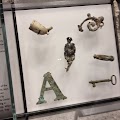
But! among the excavations for constructing the new building, workers found some interesting Colonial artifacts from early New York. Most of lower Manhattan was built over a landfill. These artifacts pre-date the Revolutionary War, unearthed in 2006. One of them a clay pipe bowl, another a key, a letter "A", and a tiny minute man figure. It's fascinating to imagine who they might have belonged to.
As time will permit, I will highlight some other finds from my trip, but for now, I am drowning at the desk!


Thursday, August 14, 2014

An Amazing Find!

In the Summer of 2010, archeologists discovered the remains of an 18th Century ship at the World Trade Center's new construction site. Can you imagine the amazement?!

The ship was unearthed and after study, it is determined that it pre-dates the American Independence! Scientists at Columbia University found that the wood used in the ship's construction came from a Philadelphia-area forest from 1773, before the Declaration of Independence was signed. It was further investigated that the ship was fashioned from the same kind of oak that was likely used to build Philadelphia's Independence Hall.


It is a sloop ship, designed by the Dutch, to carry passengers and cargo. Finding show that after sailing for 20-30 years, pieces of the 32-foot ship were used for landfill to extend lower Manhattan.

Currently, The majority of the ship's remains are being kept at Texas A&M University, and owned by the Lower Manhattan Development Corporation. There is talk of preservation or a recreation of the sloop, but time will tell. There are no plans at present.


Wednesday, July 16, 2014

The Key to Freedom

Bastille Day is celebrated on July 14, and so it is not too late to comment on it. In France it is known as La Fete Nationale, or national celebration. It marks the storming of the Bastille in 1789, the beginning of the French Revolution. The Bastille, formally known as the Bastille Saint-Antoine, was a fortress in Paris, used as a state prison by the kings of France.

Basically it serves as the "shot heard 'round the world" for the French people, fed up with the ill-treatment by the royals. Things had gotten so bad, that Louis XVI did meet with the Estates-General who represented the common man, to hear their grievances. There was hope for the drafting of a constitution, but it was not to be. By July 11, the finance minister who was sympathetic to the people, was dismissed, and the people stormed the fortress to gain ammunition and gunpowder to arm themselves against the monarchy. The Bastille also held political prisoners, and though only about seven inmates were confined, their release was symbolic.

Shortly after this event, on August 4th, feudalism was abolished, and on August 26, a declaration of the Rights of Man and of the Citizen was proclaimed.

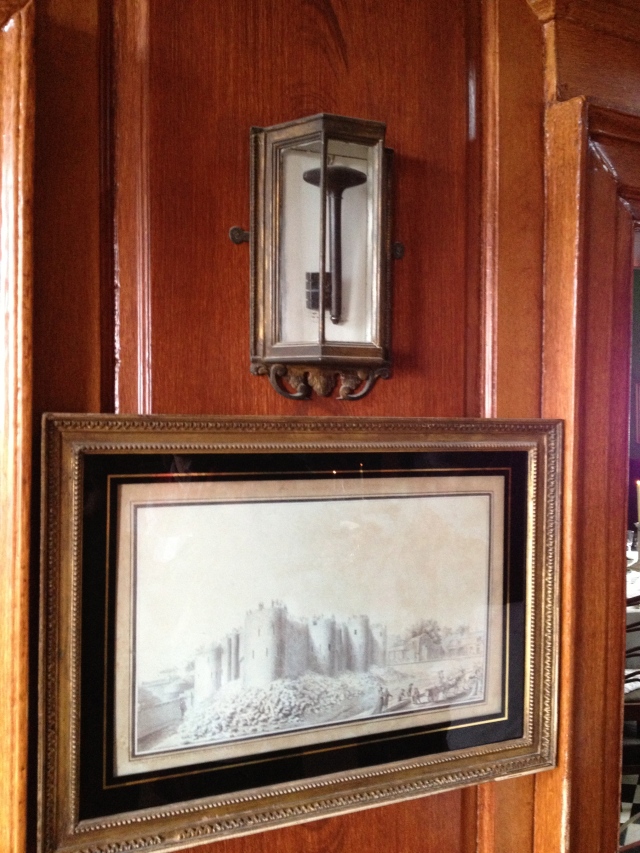
An interesting bit is that the young Marquis de Lafayette quickly assumed a role in the Revolution. He was placed in command of the local national guard formed to keep order. The main key to the Bastille was given to him by angry citizens making a gesture of freedom. Lafayette was also optimistic about the American Revolution, and decided to ship the key to George Washington in March 1790. He entrusted the key to Thomas Paine, who in turn gave it to John Rutledge, Jr. to have the honor of handing it to Washington!

Made of cast iron and weighing in at only one pound, three ounces, it is a heavy symbol, indeed. Washington displayed it in the presidential household, then later in his home in Mount Vernon in his entry hall where it remains today.


Monday, July 7, 2014

Up, Up and Away!

Over the weekend, I watched the wonderful HBO mini-series, John Adams. The story of the American Revolution is exciting and moving, and the character portrayals in the series are so vivid. You really get the sense that these were real people, with all their good and bad points, strengths, weaknesses, hopes and desires.

One of the scenes that caught my attention was the one in which Thomas Jefferson, Abigale and John Adams watch the ascent of a hot air balloon, joined by commoners and court members dressed in silks and satins, powdered wigs. Jefferson looks filled with hope; Adams is typically skeptical. The musical score, composed by Joseph Vitarelli, truly sets the tone of the scene. We are transported, we ascend as well. It's time to not only marvel along with the observers at this great event, but to get out the Kleenex box! Things will never be the same!
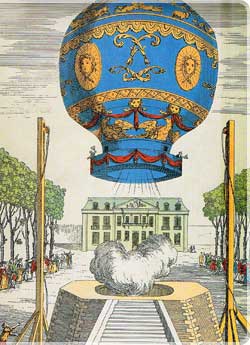
And so, the hot air balloon is the oldest, successful manned technology for flight! On November 21, 1783, the first manned and untethered flight was performed, carrying Jean Francois Pilatre de Rozier and Francois Laurent d'Arlandes into the air above Versailles, with King Louis XVI and Marie Antoinette watching along with everyone else. The balloon was built in December 1782 by the Montgolier Brothers, Joseph-Michel and Jacques-Etienne. The Montgolier family actually were paper manufacturers and their company still exists today.

The Chinese of ancient history actually utilized the concept of hot air to float lights in the air, about 250BC, and there were other attempts to lift small things, but nothing like an entire structure with passengers! The Montgolfiers first tried an unmanned flight, lasting 10 minutes, in September of 1783, a tethered manned flight achieved in October, but the climax was in November with the two men ascending, looking down on the crowd below, without a safety net, so to speak. Funny thing, but King Louis wanted to send a couple condemned criminals up for the test flight, but the idea soon sank, with de Rozier and d'Arlandes petitioning for the honor of being the first.

Take a look at the beauty of the scene:

 
By the way, the first military use of the balloon was at the battle of Fleurus in Europe, 1794, the aircraft being used for an observation post!

Thursday, July 3, 2014

Happy 4th of July!

I don't know where the time has gone, but here we are in July, ready to celebrate the 4th once again! There will be picnics and bbqs and beer and flags and cakes with red and blue berries. A relaxed long weekend for most.


The story of our American Independence generally stops with our declaration of independence from Britian in 1776. But truly, that was just the beginning. It's one thing to declare; it's another to commit for the long haul, to make it work, to keep the dream alive and make it a reality.

And so, the fight continued, actually until 1783 with the Treaty of Paris, signed by the new nation and the Brits. The United States took possession of practically all the territory east of the Mississippi river and south  of the Great Lake, and set up a representative government from the areas. There was much debate about a strong central government v. states rights. The strong central idea won out and the Articles of the Confederation with all the details was ratified in 1781. 

General Washington could not know that the Brits would not reopen hostilities! And, the French had departed, so the new country was on its own. The treasury was empty and unpaid soldiers were angry. With a coup d'état almost taking place, the Congress promised a five year bonus for all officers to keep from "abandoning the ship", so to speak. The war ended in 1783, with a period of prosperity, and peace across the globe. The national government still operated under the Articles, until the Constitution was put into effect in 1789.

As they say, "nothing good comes easily", or "all good things come to those who wait", and so with the USA.
Let's hope that we never take for granted the glorious idea, the hard fight for, and the precious guardianship it takes to keep our freedom alive. And let us not wave our flags this 4th as pretty, festive decoration, but as the treasured symbol that it truly is!

Friday, June 6, 2014

The Pivotal Moment

D-Day! Wow, seventy years have passed. I've been in my WWII mode, looking at various excellent programs and books about the war, watching Band of Brothers, based on Stephen Ambrose best-selling book. It's a beautiful story, a true account of Easy Company, 2nd Battalion of the 506th Parachute Infantry Regiment of the 101st Airborne Division, the "Screaming Eagles" as they were known, of the United States Army. At the time, the air corps was part of the US army.
The 6th of June, 1944, was a pivotal moment in world history. Got me to thinking about a pivotal moment in the American Revolution. At least one is the Battle of Saratoga, with General Gates of the Continental Army forcing the surrender of British General John Burgoyne and his army. Not only a huge victory for the Continental Army, but it convinced the French that the Americans could win the war! It is then that the French started sending supplies and monies to America. Were it not for this help, perhaps the War of Independence would have had a very different outcome.
Even then, the various countries around the world did not live in a vacuum. The allied victory on the beaches of Normandy was the turning point, and gave the Germans a heads-up. We would be taken very seriously that day forward; the Battle of Saratoga, only 167 years before (September 19, 1777), gave Britian a head-up. The Revolutionaries meant business. And, the rest is history!

Wednesday, May 28, 2014

Old Nevada


I just returned from a few days out of town, to explore old mining towns in Nevada. It was an adventurous, good time. Nevada, by the way, comes from the Spanish meaning "snow covered"! And, us Nevadans don't like the state's name pronounced with a "soft" A. We like the "hard" A like in "BAD".
I wanted to blog about the area, about 2-1/2 hours (depending how you drive, ha ha) north of Las Vegas, up US 95 Highway.   

There is not much history documented about Nevada before 1861, but I did find a few "nuggets" of information that might be of interest. As we know, Native Americans of various tribes roamed the land of the region, but it was Francisco Garces, who became the first European in the area. Garces was a Spanish Franciscan friar, a missionary and explorer. He lived from 1738 - 1781, exploring much of the Southwest. He is even credited with giving the Colorado River its name. He was eventually murdered along with his companion friars during an uprising of the Indians, and has been declared a martyr for the Catholic faith.

The area of Nevada became part of the Commandancy General of the Provincias Internas, part of the Alta California, or Upper California province in 1804, when the Californias were split. Nevada was annexed as part of the Spanish Empire, in what became known as New Spain.

The US was eager to expand into the Southwest to develop farms and settlements, with the national government initially seeking to purchase Native American land by treaties, though the settlers did not like the idea. The US policy toward the Natives continued to evolve after the American Revolution. George Washington believed that they were equals, but that their society was inferior, so he developed a policy to encourage the "civilizing" process. His six point plan included:
 
1. impartial justice toward Native Americans
2. regulated buying of Native American lands
3. promotion of commerce
4. promotion of experiments to civilize or improve Native American society
5. presidential authority to give presents
6. punishing those who violated Native American rights.


And so, here is a little bit about 18th Century Nevada. Actually, there is a lot of fascinating information about the state during the mid 1800's with the mining boom, the Comstock load, in Virginia City and later in the Tonopah and Goldfield area in 1905. Check it out sometime. Those stories are "golden".

Tuesday, November 26, 2013

A Bountiful Heart

With Thanksgiving rolling around, I take a bit of time to reflect on what's considered the "traditional" Thanksgiving meal. We have in this current century elevated this holiday fare to gargantuan proportions. A reasonable meal just will not be considered. Something about abundance and the bountiful buffet, as it were.

Probably the Thanksgiving meal of the 18th Century was quite different. I'm sure the historic meal between the Colonists and the Indians was cause for celebration, but not to the extent of today's enormous spread.

The most common foods in the Colonies were corn, maple sugar and berries. Meals were planned around the workday, with the mid-day meal being the largest. Meats were generally roasted or dried, and there were pickled goods as well. A tasty treat was molasses, and cider or beer was offered. One-pot stews were also big, with various root vegetables added in. Of course, ground meal breads were made probably daily.

And so, I provide a recipe below for the good of the day, a simple "Indian pudding", a recipe from the American Cookery book, published in 1796. It includes "3 pints scaled milk, 7 spoons of fine Indian meal, stir together while hot, let stand till cooled; add 7 eggs, half pound of raisins, 4 ounces butter, spice and sugar; bake one and a half hour."

Granted, it got a lot of cholesterol going on in there, but what with working the fields on a daily basis, you probably could get away with it. I would go for cinnamon and some clove as the "spice" component, and the sugar should be raw, or brown, at least, or better yet, molasses.

This year, try to keep things simple, and put the greatest amount of effort into a bountiful heart.


Wednesday, November 13, 2013

To be or not to be HEALTHY!

Last night I watched the PBS American Experience special, JFK. Of course, John Kennedy is immortalized, or rather frozen in time, as one of the great presidents of the 20th Century. The times were much different than today, when all, and I mean ALL, is revealed by social media.

There was great mention made in the TV special, that Kennedy was never truly a healthy individual, beginning from childhood. He was considered rather puny, suffered infections, bouts of sickness. And then, he was diagnosed with Addison's Disease, an endocrine disorder. The medication he was given had terrible side effects including destroying his bones, which led to his chronic back problems as a adult. In fact, when he met with Nikita Khrushchev at the famous Vienna Summit, Kennedy was shot up with amphetamines and various pain killers in order to make the appointment! No one knew too much about this side of his life. These things were kept mostly hidden, and he, when he ran for office, made the great effort to appear young, strong and vigorous. I wonder if he would have gotten elected at all if these problems were truly made known at the time.

It got me to thinking about our first president, George Washington, and what I may find out about his health. Granted, more people suffered various diseases and illnesses more commonly as there were no real medications to work with. It was just a fact of life that people lived with maladies. But, I did find an interesting chart that shows Washington's age and corresponding illness and year. He is shown to have recurring bouts with malaria, tuberculosis and dysentery. We all know he suffered from rotting teeth, eventually having to use dentures. As they say, bad teeth can be a sign of bad health.
    
Age Year Disease
--- ---- -------
 ?? ???? diphtheria 18
 17 1749 malaria
 19 1751 smallpox
 19 1751 tuberculosis
 30 1752 malaria
 33 1755 dysentery (+)
 35 1757 dysentery (*)
 35 1757 tuberculosis (*)
 39 1761 malaria (**)
 39 1761 dysentery (**)
   Age Year Disease
--- ---- -------
 47 1779 quinsy
 52 1784 malaria
 57 1789 carbuncle
 58 1790 pneumonia
 59 1791 carbuncle
 66 1798 malaria
 67 1799 epiglottitis[?]
+ = multiple episodes
* = simultaneous illnesses
* * = simultaneous illnesses

It was lucky for us that Washington's health was comparatively good during the Revolutionary War (1776-1783)!