Monday, May 19, 2014

Bowled Over!

Last week there appeared a news item that I found interesting. I love Thomas Jefferson, and when I saw his name in the headline, I had to see what it was all about.
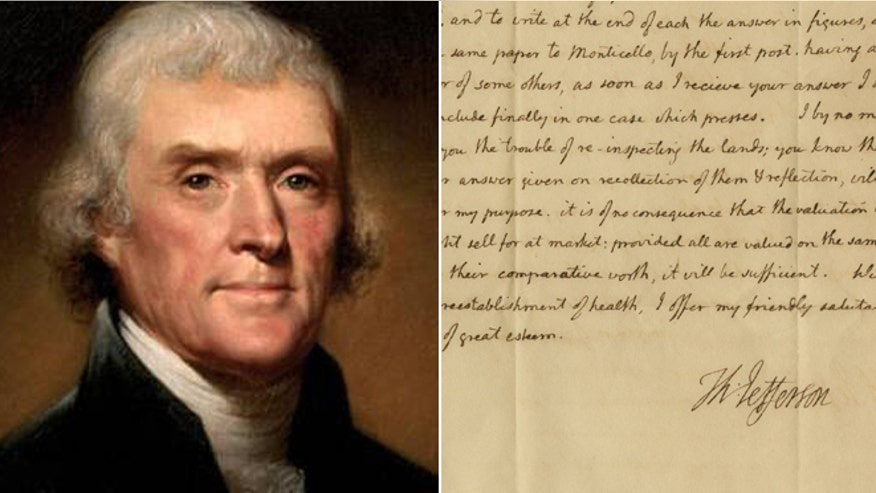
Apparently, a dealer of historic documents was selling a letter Jefferson wrote in 1805, all for the nominal price of $35,000!
It was a letter that Jefferson, president at the time, wrote to a friend, his estate manager, discussing the president's desire to have his forest of poplar trees appraised. The poplars were planted at his Virginia plantation. He was 62 at the time, and looking to portion off portions of his property to his grandchildren. It is a glimpse of Jefferson as a family man, concerned about the future, when he is gone.
jefferson3.jpg

It is a one-page, handwritten document that belonged to an anonymous collector, and now Raab Collection of Philadelphia will conduct the sale. Perhaps the anonymous collector is disposing of his property too.
Let's hope a museum purchases the letter, so perhaps we can enjoy seeing it occasionally. It's interesting to see one's handwriting, to analyze its characters, allowing us an insight into the man. Did he write it carefully? Was he in a hurry? Did he scratch out a word or two? (Remember, there was no wite-out then). Did he use correct punctuation, word spelling? From the fragment of the letter above, it looks like he was a careful writer.
Below, is a picture of a poplar at Monticello. Quite large, isn't it? I wonder if it was there when he built his estate, or if he planted the young tree near his windows? Well, it is quite spectacular now.
Above right is another view of the Monticello estate. You can see the plantation as it moves into the distance. And also pictured above is an example of a bowl made from poplar wood that is sold at the Monticello estate gift shop. Each one is different, and beautiful. I think I'd rather have the bowl than the letter. The artist is Frederick Williamson, and you can see how he cuts out pieces of fallen poplars, and then sets to work. At about $350 a bowl, I think it might be easier to spring for!!

Friday, May 16, 2014

One Two Punch

 
The other night I watched "Cinderella Man". Such a good movie about the pugilist James J. Braddock, who was a boxing champion before the Crash of 1929, and then again later with his Heavyweight championship bout against Max Baer in 1936. It's the kind of movie that whether you are a boxing fan or not, you can't help get involved. It's nail-biting. It's talk back to the screen, "C'mon, man! Knock him out!" Frankly, I cried at the end. Braddock's portrayal is the good guy, dealt hard knocks in and out of the ring, but he prevails.

Got me to thinking about boxing, its origins, and its development in the 18th Century.Actually, sports like boxing were popular in ancient Greco-Roman times, but in the 5th Century, Emperor Theodoric the Great banned the excessive violence.


The ban stayed in place for over 1,000 years, then revived in the 17th Century in Britian. Though still illegal, boxing was promoted with a first bout taking place in 1681, with the 2nd Duke of Arbemarle arranging a contest between his butler and his butcher! The butcher won.

By the early 1700's prize fighting became a craze in England, even bouts being hosted in the Royal Theatre. A purse was established, but even fighters took side bets. They were furious contests with NO referee to keep order!

But with boxer James Figg, things began to change. He used some of the technique he acquired from fencing. He was a champion from 1719 to 1730, fighting about 300 times, winning every one! When he retired, he set up an actual school for the sport, where athletes could train.
 

One of Figg's students, Jack Broughton became the bare-knuckle champ from 1729-1750, with one opponent, George Taylor, dying as a result of injuries. Broughton was later known as the Father of English Boxing, because with Taylor's death, he established better rules and safer equipment."Boughton's Rules" as they were called, provided for the knock down count to thirty to get up or the match was called. Punching below the waist became outlawed, and he introduced "mufflers", a type of glove, for training.

In 1791-1795, Daniel Mendoza led the pack. Weighing in at 160 pounds, he emphasized speed and agility, "fancy footwork".


And then there was John "Gentleman" Jackson, an excellent fighter, a champ for one year in 1795, though he retired early, he brought the aristocracy the art of boxing, and one of his more affluent students was Lord Byron!


I found some of this research fascinating; interesting to see the development and evolution of a sport that is gritty and violent, yet has had its elegant and stylish moments, and of course, everyone enjoys an underdog win. Unfortunately, the boxing, in my opinion, has become really corrupted and ugly. Its ties to World Wrestling and all the antics, dilutes the contest. The enormous amounts of money involved bring a different group of fighters and promoters to the table, and that gives the sport a black eye. 

Wednesday, May 14, 2014

Waxing Nostalgic

Madame Tussaud
When you hear the name Madame Tussaud, it conjures up all kinds of weird and unsettling thoughts, of Vincent Price and The House of Wax, the chamber of horrors, or dark, scary nights in a closed museum, etc etc.

Her story is interesting, not gruesome, but a bit strange as it involves our fascination with the macabre, death, preserving moments in time. People always imagine wax figures or mannequins coming to life after midnight.

Marie Tussaud was born in Strasbourg, France, in 1761. Her father died in the Seven Year's War. She was just two months old, and so her mother took her to Bern in Switzerland where she worked as a housekeeper for a Doctor named Curtius, a physician and wax sculptor. Marie would call Curtius her uncle, and watch him sculpt figures to illustrate anatomy. Later he started doing some portraits.

Curtius moved to Paris in 1765 to display his "cabinet de portraits en cire" (wax portraits). In 1782, he exhibited a second collection, the Caverne des Grand Voleurs", a precursor to the Chamber of Horrors. He sculpted Louis XV's mistress Madame du Barry, then placed her on an apparatus that allowed the sculpture's body to rise and fall as if breathing in her sleep. It was known as the "Sleeping Beauty". The exhibit was very well received!

File:Sleepingbeautytussauds.jpg
Marie eventually worked for Curtius as an artist, and by 1777 she created her own first work, Voltaire. From 1780 to 1789, she did many of her most famous portraits, including Ben Franklin, and members of the French Royal family. She said the royals liked her so much, that she was asked to live with them  at Versailles?!?! Hmmm!

In 1802, Tussaud moved to London, eventually to Baker Street (of Sherlock Holmes' fame). BTW, Baker Street is named after builder William Baker, who laid out the street in the 18th Century. Tussaud went to London on an invitation from Paul Philidor, phantasmagoria artist (a form of theatre which used a "magic" lantern to project frightening images like ghosts or skeletons onto a wall using rear-projection) to exhibit her work along side his at the famous Lyceum Theatre.

By 1837 she had her own wax museum, featuring victims of the French Revolution, as well as criminals and murderers of the times. Some of her original works are still on display in London's Madame Tussaud museum, including death masks, and Sleeping Beauty! I guess you can last a long time on a good night's sleep!

Monday, May 12, 2014

My Baby wrote Me A Letter!

The other day I read an article about a young woman that was very seriously ill, and rightfully depressed about it almost to the point of suicide, but she felt if she got up each day, and wrote to someone, even a stranger, to encourage THEM, she might in turn find some peace and happiness for herself. She used her Facebook to reach out, and told people if they gave her an address, she would write to them, a handwritten, encouraging letter with a stamp, coming to their mail box! The response was overwhelming! She wrote over 3,000 letters. People shared their problems, hurts, sadness with her. She said the letter she would send would be something they could keep, and pull out of their wallet, or purse, or desk, and know that someone cared.
In today's world, many people are isolated, and even though they communicate with strangers over the internet, something is missing. That bit of humanity that real correspondence can bring. The fact that she needed to find a support system of her own is telling.
The written word is a beautiful thing. There is something magical about opening the mail box and finding an actual letter. It may not be immediate news, but it lets someone know that you sat down, and took the time to write you their thoughts.
The art of letter writing is almost lost.
In the 18th Century, the etiquette of a letter was extremely important. Letters were very different then. For one thing, they were formatted as "cross letters", which actually saved the recipient money! A recipient paid a fee based on the letter's size and the distance it travelled, so in order to conserve space, someone wrote down the page, then turned the paper and wrote again, over the original sentences.
Also, there was no standardized spelling, so often, a "Y" was used in place of an "E", as an example.
Every quill was unique, and took some time to prepare in order to write. And, of course, the quill would only last so long.
Formality and protocol was also very important. For non-military letters, you could end with the following type of greetings:
 
Believe me yours faithfully,
Belive me, dear Sir, Your obliged and faithful humbl. sert.,
Belive me at all times with sincerity and respect, your faithful and obliged servant,
Yours ever,
Affectionately yours,
With best love, &c., I am affectionately yours,
I am yours ever,

But if you were in the military, there were other specific, more formal greetings:

Yours faithfully,
Very respectful,
I have the honour to be, &c.,
Your Obliged, &c.,
I am, &c.,
Your most obedient servant,

  
Then, one would close with rank, and the name of their ship, as the address. Now picture an officer  of the British Royal Navy mailing a letter to a loved one, while he is somewhere at sea, in the Atlantic. He would write his correspondence, sometimes adding to it day after day, until his ship crosses paths with another friendly vessel bound for England. This may involve weeks, or months. Only then will his correspondence have a chance to make it to its destination. Precious, indeed, will this small, folded and waxed-stamped piece of paper be! By the way, envelopes came much later, so letters were folded and sealed, and hopefully no one made attempts to open them.

Wednesday, May 7, 2014

St. Gallen and the Textile Trade


Yesterday morning I saw a travel program on St.Gallen, Switzerland that caught my eye. St. Gallen is the capital of the canton of St. Gallen. (A canton is a member state, of which the federation of Switzerland has 26 cantons.) St. Gallen evolved from the hermitage of Saint Gall, from the 7th century. Today St. Gallen is a large urban town, having an attractive tourist attraction, the Abbey of St. Gall, containing a priceless library of books dating to the 9th Century of over 160,000 items.

The most interesting thing though, 18th Century speaking, is St. Gallen's embroidery trade which flourished in the early 1700's. In 1714, yearly production reached 38,000 pieces of cloth, including handmade lace and embroidered cloth of incredible design, all this done by hand! By the middle of the 18th Century, however, strong foreign competition caused an economic depression for the region, but by the early 1800's, the first embroidery machines were developed in St. Gallen, and production continued! Today, computer operated machines have increased competition across the globe, but if haute couture designers want something Very special, they still visit St. Gallen. 

  There is a fabulous textile museum in the town that highlights the history of St. Gallen's textile industry, see website address below. That's something I'd like to see! 

Monday, May 5, 2014

The Battle Ensign

The other night I watched Master and Commander again. I have seen it so many times, and yet it never disappoints. Each time, though, since I know the story by heart, I look for other things, sometimes something small that peaks my attention.

This time it had to do with disguise and going into battle. Captain Aubrey is bent on taking a French enemy ship as a prize. His friend and naturalist Dr. Maturin is showing him a particular find from his explorations around the Galapagos Islands. It appears to be a stick, but on closer viewing, Aubrey is surprised to see that it is an insect that has disguised itself to avoid any predators. Aubrey receives a flash of inspiration: If he disguises his ship, the Surprise, as a whaling vessel, perhaps the enemy will want to investigate and then Aubrey can spring his trap! And so the captain paints and cloaks the Surprise in "whaler" disguise, going so far as to burn old rope that creates billows of smoke, like a whaling ship might appear as it burns whale oil.  And a rather obscure and generic flag is flown.  
 
But at the precise moment before battle is to ensue, Aubrey cries, "Let fly!" and the ensign of the British Royal Navy is immediately hoisted up, a declaration of military intent. I love that part...it is a gesture of honor and protocol of battle. These things are not to be taken lightly.


A battle ensign is the name given to a large war flag which is flown on a war ship's  mast just before going into battle, identifying the allegiance of the ship, in what might be considered a confusing situation, with cannon fire and smoke and sails all fighting for attention. That is why the ensign is quite large, about 20x40ft. It was commonly accepted that as long as a ship flew its ensign, it was an active and legitimate participant in battle; prior to action, it was acceptable to fly a false flag.

The ensign is flown from an ensign staff at the stern of the ship, just behind the quarterdeck, which is the holy of holies, where the captain stands.
If a ship surrendered, its flag must come down, and hence the phase, "strike one's colors". Of course, the British Royal Navy did not give up easily, and so another phrase, "nail one's colors to the mast" indicated that they were determined to fight on and NEVER surrender! The battle ensign is a matter of morale to its crew. If a ship was to sink, a senior officer was entrusted to see that the flag was saved. No matter what other flags are flown from any other or higher masts, the stern is always the superior flag location. The battle ensign features the white field with red cross of St. George, patron saint of England, and the union jack in the upper right hand corner.
 
And the final honorable gesture, if a ship is defeated by another, the captain surrenders his sword to the winning captain. That will be investigated another day, but for today, the ensign is our concern.

Friday, May 2, 2014

An Ounce of Prevention

The past couple days have been hell for me. The winds and pollen are up in the desert this time of year, and they can really wreck havoc on those prone to allergies. Basically, I don't like to take medicine, generally leaning to natural remedies if possible.

It got me to thinking about what people did in the 18th Century to cure colds, allergies, "maladies" as they are often referred to.  At that time, women of the household were in charge of making and dispensing remedies for common complaints, these being for the most part, herbal. Part of a young girl's education included learning recipes for these concoctions. Sometimes a remedy was just the drinking of hot wine made from elderberries, but often cures called for the making of a syrup, or an herbal tea, or lozenges produced then hardened into a candy. There is an interesting book called the Accomplish'd Gentlewoman's Companion, written in 1753, a cookbook by Eliza Smith, published in London, that records many of these homeopathic recipes.

Taken from "The Art of Cookery made Plain and Easy", here is a interesting recipe: "Take pearls, crab’s-eyes, red coral, white amber, burnt hartshorn, and oriental bezoar, of each half an ounce; the black tips of crabs-claws three ounces; make all into a paste, with a jelly of vipers, and roll it into little balls, which dry and keep for use."


By the way, "homeopathy" comes from the Greek, "homios" meaning "similar", and "pathos" meaning "suffering". Homeopathic remedies can be harmful if one doesn't take care. Herbs are not always easy on the system, though they can purge and thereby rid the body of toxins. The homeopathic cure was evolved by Dr. Samuel Hahnemann, a German physician, in the late 18th Century. He was appalled at medical practices of the times, and sought a better and safer way.  Basically the homeopathic way allows the body to heal itself.


"Dr. Hahnemann's classic example was when he took cinchona bark, he became ill and his symptoms mimicked that of malaria. This means that the bark of the cinchona tree which can cure malaria when prescribed to a person inflicted with malaria can actually produced malaria symptoms when given to a healthy person. He continued to experiment and he eventually established the fundamental principles of the science and art of homeopathic cure - "let likes be treated by likes" and he treated the sick based on this principle."
Below see a list of remedies by category:

An infusion: A liquid made by soaking an herb – usually its dried leaves or flowers – in liquid. An herbal tea is really an infusion.
A decoction: A liquid made by boiling an herb.
A poultice: A soft, moist mass of bread, meal, herbs, etc. applied to the body.
A plaister: A solid or semi solid remedy, spread on cloth or leather and applied to the body.
An electuary: Powder dried herb and mix with three times as much honey.
An oil: Fresh or dried herb is soaked in oil to extract the essences of the herb. Usually applied externally.
An ointment: Fresh or dried herb is soaked in lard to extract the essences of the herb, then mixed with beeswax and turpentine. Applied externally.