Wednesday, October 9, 2013

Halloween Tunes

It's October, and Halloween is generally in my thoughts. I love the on-set of the Fall.     I have taken down my Summer door wreath, in favor of one with all the autumnal colors. Later in the month, I will exchange that for a more ghoulish one.

As is fitting this time of year, I get out the appropriate music to drive along with. Years and years ago, my daughter and I bought a compilation CD of Halloween-inspired tunes, "The Fright Night Classics", including Night on Bald Mountain, Swan Lake theme (remember Dracula?), Danse Macabre, March of the Gallows, the Witches Sabbath. I love to hear all the music, not only to get in the spirit of the season, but it's nostalgic of making Halloween costumes, carving pumpkins, collecting candy with my daughter.

I also like to hear some of Nightwish's rather Gothic selections, as well as another compilation "After Dark", more Cult and Bauhaus-type selections. "Bela Lagosi's Dead" and "Lucretia My Reflection" are particular favorites.

But this year, I decided to include Mozart's Requiem. Written in 1791, this Mass in D Minor is famous for some "mystery" that surrounds it. Actually, it's just that he wrote it on his death bed, and it was left unfinished, for his fellow composer, Xaver Sussmayr, to complete it. Of course, he followed the sketches Mozart had fleshed out, delivering a glorious work to Count Franz von Walsegg, who had anonymously commissioned it to commemorate the death of his wife. As Mozart was only paid a deposit on the work, his wife Constanze was quick to get it published! Thank you, Stanzie, for that!

Typically, the requiem is a mass to celebrate the souls of the dead, in a Latin format, the Roman Missal, organized as follows: The Introit, Kyrie Eleison, Gradual, Tract, Dies Irae, Offertory, Sanctus, Agnus Dei, Communion, Pie Jesu, Libera Me, and finally the In Paradisum.

Mozart's work is scored for horns, bassoons, trumpets, trombones, timpani, violins, viola, cello and organ. The vocal parts include soprano, contralto, tenor, bass as well as a full choir. It's basically the full-nine-yards!

By the time you take the journey through all the sections, you have traveled from the petition of prayers for mercy, a look at Judgment and Hell, to the to the soul's arrival in Paradise (assuming the Powers-That-Be deem the particular soul in question worthy!).

Give it a listen this season. I'm sure you will be uplifted by its beauty, and you can think that it is one of the prettier things about the Halloween season.


Tuesday, October 8, 2013

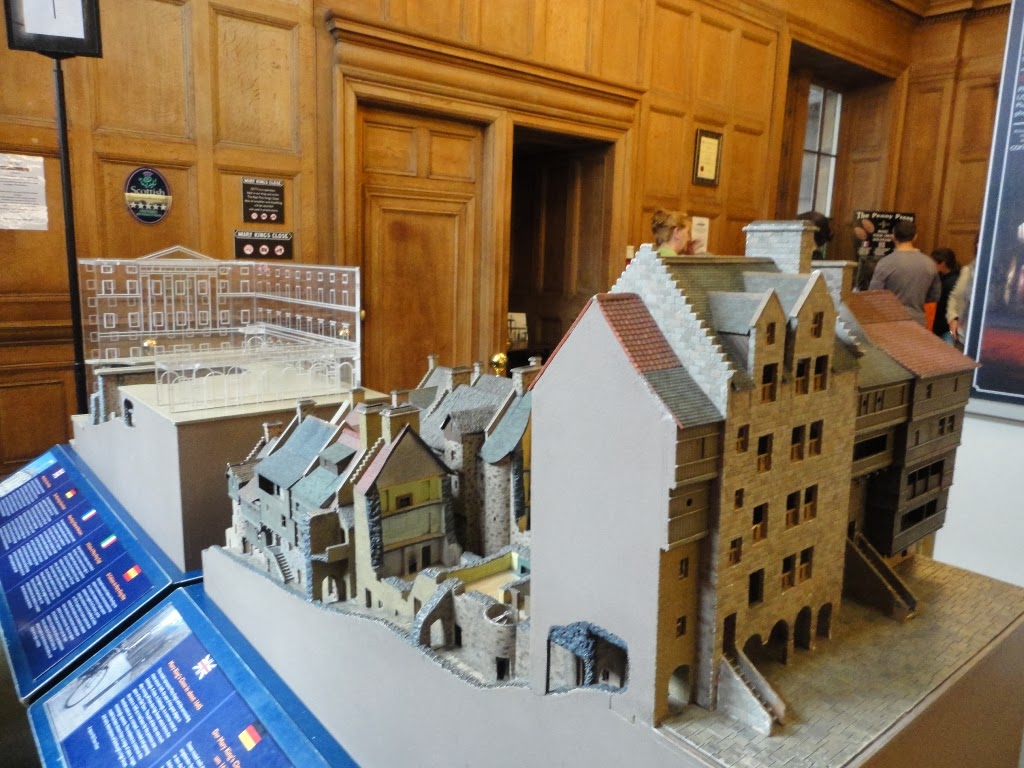
The Mary King Close

Travel, as they say, is broadening. You never know what new thing you will encounter or learn about.

When I was recently in Edinburgh, we made a visit to Mary King Close, on the Royal Mile (high street). It is an very interesting, and curious place. To begin with, Edinburgh is built on a rock with the high (or main) street built along its highest point. Off the high street are a series of tiny streets, called "closes" that run perpendicular to the main thoroughfare.
They are more like alleyways than anything else, where mostly the poor made their residence in incredibly small cubicles. The closes were often named for prominent citizens, business people who acted as landlords. Mary King was such, offering tenement type living arrangements for townspeople, in 1630.


The Mary King Close residences were well beneath the city's street level, many stories down, as a matter of fact. The close was dark and dank, and a breeding ground for mystery and myths, and tales of ghosts. Many a person died down deep in the close, and there was disease and murder and bad dealings in abundance. At right and below is a model of the dwellings, above and below grade.

Though it was built in the 17th Century, it remained active until 1753, when it was eventually built over during a "modernization" period, and the lower floors became the foundation of the Royal Exchange (the City Chambers).

You can take the tour, venturing ever deeper into the dwellings. Life in 18th Century Edinburgh was difficult for many. The city was terribly overcrowded, and conditions in the close did not offer anything better. Until there were actual sewers, waste and trash were just thrown out the windows of the dwellings, down to the bottom floors. Only rain, when it rained, helped wash the stench and germs away. The Black Plague and bubonic plague ran rampant. It was obviously better to live on the upper floors, if a "residence" became available. As they say, it was fun to visit, but I wouldn't want to live there!

And, today, no one lives there, thank goodness, but for the ghosts!


Wednesday, October 2, 2013

In Praise of the Past

Well, I met my lovely daughter this afternoon for coffee, and she told me all about her attendance at the annual Road to Regency Ball in Old Town Alexandria, VA. Along with her husband, they attended, in full regalia.... Regency costume, wigs, fans, tri-corn hats, and all. For more information, you must see her blog: http://dressedintime.blogspot.com/

My daughter is quite a seamstress for these kinds of historic clothes, and what a wonderful opportunity to express one's creativity, and historical accuracy, but at an event like this!

Held at the famed Gatsby's Tavern, in their upstairs ballroom, you can imagine yourself back-in-the-day, sipping cordials, expressing social cues with your fan, skipping to the beat of country dances.

I've had many a lovely, and tasty, dinner at Gatsby's over the years. Gatsby's has been serving fine food since the late 1700's, to hungry Colonials, including George Washington. I particularly like their peanut soup, and the "George Washington Favorite" grilled breast of duck with corn pudding, or the "Gentleman's Pye" featuring lamb and beef in a savory wine stew. I just love this place!

But, having dinner there, and going back in time, so to speak, is another thing. Makes me want to time travel next time they do this kind of thing!

Tuesday, October 1, 2013

Getting Back to Business!

Well, I am finally back at my desk, since my wonderful Scottish fling, and then my annual "labor of love", working our local church Greek Food Festival, held every late-September here in Las Vegas. The weather was glorious, almost Autumn, and I was responsible for decorating the grounds. Of course, when the Festival opens, that work is done, so then I helped prepare salads for hours each day, then welcomed people at Admissions in the evening until closing.

So, I have to admit, I have not been diligent herein, and I feel quite guilty. But, I have truly been too busy to be inspired, and so I promise to get down to business again right now.

And, what more beautiful place to start than with than the place I stayed in the Scottish Highlands, the beautiful Culloden House. The history of the house, and the ensuing Battle of Culloden, mark a turbulent time in Scottish history, namely the Jacobite Rising, about 1745. At that time, Bonnie Prince Charlie used the house as his lodgings and headquarters prior to the battle.


In the 18th Century, Inverness, the capital of the Highlands, attracted the wealthy to the region where they settled, enjoyed the diversions of the day, balls, assemblies, etc. A group of manor houses sprung up in the countryside, Culloden being one of the nicest, on 40 acres of parkland.

Actually the history of the house goes further back, to 1625, with Duncan Forbes, a wealthy gentleman, purchasing Culloden from the Macintosh chieftain, holding it in the Forbes family for the next 300 years.

Later, another Duncan, became Lord Chief of Justice in 1745, suffered at the hands of the Jacobites, having the house occupied and plundered. Duncan was appalled by the battle of Culloden and urged George II not to inflict hard punishment on the Highlanders, but George II did not listen. Consequently, the Highlanders even lost their right to wear the Tartan plaids, and play their bagpipes. They were stripped of their cultural heritage. Duncan, it is said, died of a broken heart a few years after the battle. Later Forbes family members restored the house to what it looks like today, and the beauty of that is that you can stay there, which is a peaceful and lovely place set away from the city.

At left, see the beautiful front grounds and the dining room. Below, is the typical British lounge, for reading, chatting, taking tea, playing a game of chess. Of course, the chessmen are Highlanders here!

And of course, what would a manor house be without its formal garden. The "Forbes" garden, as it is called, graces part of the acreage, fit for a lovely stroll in the morning, or afternoon.

It makes me awfully happy to know that this lovely place, from a grand old time, remains looked after today. It was a joy to stay here! And,....I liked the vast selection of scotch in their bar room, but that's a story for another day!


Monday, August 26, 2013

Highland Fling

Well, in two days I shall be off to Scotland. First visiting Edinburgh, then up to Inverness in the Highlands. I am so looking forward to visiting the castles, museums, the shopping and the general colorful environment. But my romantic heart wants to see something like what is shown in the landscape below. Painted by Wiliam Turner in 1805, it is called 'Mountainous Landscape: A Scottish River".


Turner was English, lived from 1775 - 1851, and had the opportunity to travel a great deal, giving him time to research and record the British countryside and seascapes. His landscapes are truly original and identifiable. They seem to have an inner light, even if they are in painted in sombre colors. He captures the windswept, mournful panorama of the Scottish highlands in this work to perfection.

His father died in 1829, and had a profound effect on his life and his work. He suffered bouts of depression. Some of that is captured in his work. It has great depth and emotion. He never married, but had a mistress for awhile in his later life. He died at her house, and was buried in St. Paul's Cathedral in London, where he lies next to Sir Joshua Reyholds, another famous British artist. Turner's last words were, "The sun is God". Above is a self-portrait, which I think is quite outstanding, and rather contemporary for the times, but he is remembered for his beautiful outdoor scenes. I hope I will see, very soon, this painting come to life!

I take leave for a couple weeks, and hope to bring back new stories! Adieu!


Thursday, August 22, 2013

Tartan Plaid

I am starting to get excited about my upcoming trip to Scotland! Next week, friends and I leave for Edinburgh and The Highlands, Inverness to be exact. I am hoping to visit some of the famous sites, and bringing them home to you in this blog.

                        I have been doing a lot of history reading to prepare, and find that the 18th Century was particularly a time of unrest and warfare, especially in the Highlands, with the Jacobite rebellions of 1715 and 1745. The Scots eventually became content with their new role in a kingdom united under Great Britian. At least for awhile.

One of the saddest things, though, was by 1745, the Tartan, the Highlander's signature dress, was banned. They were not allowed to carry arms, but the prohibition of their plaid kilts was the final insult. Every clan has their own plaid and pride that goes with. Some tartans are truly beautiful and their history goes way back.

The entimology is interesting. The English word TARTAN comes from the French TIRETAIN, from the verb refering to "woven" cloth.

The act to ban the colorful cloth was repealed in 1782, but the Highlanders pride was hurt, and you don't mess with a Scotsman!

I am hoping to bring some of the tartan fabric home with me, but, ahhh!! which one to choose? As I am not of Scottish descent, I will have to find one that speaks to me. Any suggestions? Above see the McMillan plaid. My daughter can actually claim to be part of the McMillan clan, on her father's mother's side! Years ago, I made her a skirt from fabric we ordered from Scotland. It's a very pleasing design and colors!


Wednesday, August 21, 2013

Mozart on Tour: A lighthearted moment


Every morning on my way to work, I have a chance to listen to some beautiful music. Sometimes it is my own selection, but most often I ride along with our local public station, KNPR. This morning, I was listening to Mozart, a symphony, an earlier work. Generally, I know my Mozart, and can mentally follow along with the music, but sometimes, I think it might be his work, but I’m not sure. And just when I say to myself, no, this is not Wolfgang, the announcer comes on and says, “That was Mozart’s Symphony 24 in B flat major!”
Ah! I’ve been fooled! I suppose it’s because each composer over time develops his sound! In their earlier works, they are laying down riffs, patterns, chords, sequences that begin to work for them. In later works, they count on some of these to express the mood, to round out the story. A indelible signature, like a painter’s brush strokes…Van Gogh’s squiggly lines, Hieronymous Bosch’s tight detail, Picasso’s geometry, a Turner sky.
Today, by the way, Mozart was in Bologna, in 1770, with his father. In a letter from his father Leopold  to his mother Anna Maria, Wolfgang writes a postscript that is kind of fun. He was a tourist, like any other, enjoying the different things around him, giving his impressions of people he met along the way.  I'm glad he was having a good time. Most often, when he was traveling, he was working, on tour, trying to get a commission. He was 14 at the time, and writes,
I too am still in the land of the living and, what`s more, having lots of fun. Today I was suddenly seized by the desire to ride on a donkey, as is the custom in Italy, and so I thought I should give it a try. We have the honor of going everywhere with a certain Dominican who`s regarded as a saint, though I don`t really believe it as he often has a cup of drinking chocolate for breakfast and immediately afterwards a good glass of fortified Spanish wine, and I too have had the honor of dining with this saint, who at table drank lots of wine, finishing it all off with a whole glass of fortified wine, two large slices of melon, some peaches, pears, 5 cups of coffee, a whole plate of birds and two full plates of milk and lemon; he may have done this on purpose, but I don`t think so, as it would have been too much, apart from which he also eats a lot for his tea during the afternoon. Addio. Farewell: kiss Mama's hands for me. Best wishes to all who know me.