Thursday, April 12, 2012

Thank You, Paul!

You may not know this, but Paul Revere (1734-1818), noted for his famous words "The British are coming! The British are coming!" was a silversmith in the Colonies, one noted as an accomplished engraver, so he could decorate his own pieces. Note the beautiful tea pot above, crafted in 1796, it is silver and on display in the Metropolitan Museum of Art in New York City, in Gallery 750.
Here is the museum's description:

The elegant, restrained design of this teapot, with its bright-cut swags and ornamental bands, is entirely in keeping with the Neoclassical taste that flourished at the end of the eighteenth century. Oval teapots, either plain or fluted, were among the standard items produced in Revere's shop after the Revolutionary War. They were fashioned from sheet silver, produced with the flatting mill that Revere acquired in November of 1785. Each teapot was constructed with an overlapping seam at the handle, which was both soldered and riveted. This technique produced a very strong joint, and it was also simpler for some of the less experienced journeymen and apprentices in his shop to achieve. Teapots of this model paired handsomely with similarly designed creampots and sugar bowls, also represented in the Museum's collection.

Well, I am lucky enough to own a reproduction of it! As a matter of fact, I have the whole tea set, that was a wedding gift to me from a dear relative. I have enjoyed it over many years. It was reproduced by Lunt Silversmiths, the oldest continuously operating, family-owned silver company in the United States, originally established in 1902. I think it has a timeless design, sometimes almost a modern feel, with its straight lines. Great simplicity, and so, like all good, well-designed, understated things, it stands the test of time. Thank you, Paul!

Battle of the Saintes: The Turning of the Tide!

Today marks the British victory known as the Battle of the Saintes, off Dominica, April 12th, 1782, with Sir George Rodney (shown at left) in command of the thirty-five ships-of-the-line, defeating the French Comte de Grasse, who had thirty-three ships. The action ruined French prestige with Rodney taking five of their ships, and sinking one after eleven hours of battle. Tactics played the major factor, with a lucky shift of wind that broke the French line. The battle actually took place over 4 days, forcing the French to abandon their planned invasion of Jamaica, which was strategically placed as a point of blockade action against America. Remember, the French had sided with the Colonists.

There was some controversy regarding the action. An unusual maneuver by the British ships, never before attempted in a major battle, allowed for the French defeat. They never recovered thereafter. The credit for the maneuver was fought over among supporters of particular British naval officers. The exact truth will probably never be determined, though a thorough examination of the evidence available strongly favors that of Rodney’s captain-of-the-fleet, Sir Charles Douglas.

Below is a print of the Comte de Grasse relinquishing his sword to Rodney. Ahhh, the honor of it all!

Wednesday, April 11, 2012

The National Maritime Museum and Compelling Water

The National Maritime Museum (NMN) was founded in 1937 in Greenwich, England, one of the largest maritime museums in the world.  Along with the museum, one can also visit the Royal Observatory and the Greenwich Mean Time centers, located on the same property.

But, the most important museum are the maritime articfacts mostly from the 18th Century, when the Royal Navy had reached its pinnacle, utilizing incredible technology from the Enlightened Age, including sextants, astrolabes, compasses that are not only extremely accurate for the time, but also incredibly beautiful in their workmanship. This is also the age of Lord Nelson, his ship the Victory, the famous naval tall-ship battles. Of course, Nelson's uniform is there, carefully preserved. He was a giant among naval men, though physically he was rather short, and small-framed.

One of my favorite things about the National Maritime Museum is its logo! It is "water-based" in theme, and extremely elegant. But upon closer view, one realizes that it depicts a crown! A royal crown, formed as a drop of water hits the ocean's surface! The splash is the crown! I just love it!
It is designed by the London-based company called "Someone".

This leads me to WATER! What a wonderful thing it is. Nourishing, Powerful, Mysterious, Compelling! It has an attraction for us, perhaps because we are what, 90-95% water?! Perhaps its mystery is what keeps sailors going out to sea! See below some beautiful poetry about the sea. There are so many, but here I offer a few!

Mid-ocean in War-time by Joyce Kilmer
(For My Mother)

The fragile splendour of the level sea,
The moon's serene and silver-veiled face,
Make of this vessel an enchanted place
Full of white mirth and golden sorcery.
Now, for a time, shall careless laughter be
Blended with song, to lend song sweeter grace,
And the old stars, in their unending race,
Shall heed and envy young humanity.
And yet to-night, a hundred leagues away,
These waters blush a strange and awful red.
Before the moon, a cloud obscenely grey
Rises from decks that crash with flying lead.
And these stars smile their immemorial way
On waves that shroud a thousand newly dead!
 
The Ocean's Song by Victor Hugo
We walked amongst the ruins famed in story
Of Rozel-Tower,
And saw the boundless waters stretch in glory
And heave in power.

O Ocean vast! We heard thy song with wonder,
Whilst waves marked time.
"Appear, O Truth!" thou sang'st with tone of thunder,
"And shine sublime!

"The world's enslaved and hunted down by beagles,
To despots sold.
Souls of deep thinkers, soar like mighty eagles!
The Right uphold.

"Be born! arise! o'er the earth and wild waves bounding,
Peoples and suns!
Let darkness vanish; tocsins be resounding,
And flash, ye guns!

"And you who love no pomps of fog or glamour,
Who fear no shocks,
Brave foam and lightning, hurricane and clamour,--
Exiles: the rocks!"


Monday, April 9, 2012

Bach Cello Suites

Today I've had the opportunity to listen to some really beautiful music, as I've driven about in my personal mobile concert hall! Listening to the Bach Cello Suites, as performed by Yo Yo Ma, I am transported beyond the mundane, to another place entirely, elegant, peaceful, filled with richness and warmth.

I love these pieces, just the artist and his instrument, and if you listen extremely closely, you can hear him breathe, or gather breath as he begins a particular passage. You begin to understand the concentration, the effort involved, the humanity of playing an instrument and making music. It can look effortless, but it is not.

The suites are actually Six Suites for Unaccompanied Cello, composed during a period from 1717-1723, when Johann Sebastian Bach was employed as Kapellmeister, or choir director, for a church in Cothen, Germany. The suites contain a variety of techniques and range of emotion, but it is their intimacy that makes then endure. They appear simple, but there is fierce competition between artists regarding their interpretation. Over time they have been transcribed for various instruments, including mandolin, guitar, piano, horn, clarinet, and even ukulele!

Here's an interesting bit: The suites were not widely known until the 1900's, when Pablo Casals discovered a particular edition of them in a thrift shop in Barcelona, Spain, when Casals was 13. He began studying them, and the rest is history! He did not perform them in public until 1925, when he was 48, and he agreed to record the pieces, becoming the first to record them in their entirety. There popularity them soared!
The suites are in six movements each, having the following structure and order of movements:
Prelude, Allemande, Courante, Sarabande, Galanteries, and Gigue.

Personally, I love them as interpreted by Yo Yo Ma, and I have included a couple You Tubes below for your listening pleasure. The first is joyful, celebratory; the second with such pathos that you could cry. Enjoy them, and then go out and purchase the whole set. You won't be disappointed.


Friday, April 6, 2012

The Written Word

I read all the time! Mostly history, or if it is a worthwhile one, a historic novel. Nothing is worse than reading a trashy romance novel. I would expect you would feel cheated of your time as you turn the last page.

But, fine literature, the first-rate novel, as we know it today, is a product of the 18th Century! Of course, there were stories before, but the genre that constitutes the modern NOVEL was developed in the 1700's.
Some of the literary geniuses who wrote these enduring works include Daniel Dafoe who wrote "Robinson Crusoe" in 1719; Samuel Richardson who penned "Pamela - Virtue Rewarded" in 1740; Henry Fielding, "The Story of Tom Jones" - 1749.

The NOVEL is a book of long narrative in literary prose. The genre goes back to medieval times. Novels are categorized into the following types, though within these general categories, there are sub-categories:

1) The EPISTOLARY, or a story written as a diary, letters, journal entries. The hero tells the story recalling events documented. Think of "Letters of a Portugese Nun".
2) The SENTIMENTAL, generally a love story. Think of "Pride and Prejudice".
3) The HISTORY, or historic novel, where the hero is interjected into the plot of actual, historic events. Think of "Mutiny on The Bounty".
4) The GOTHIC, the tale of horror, suspense, ghosts, paranormal. "Think "Frankenstein".
5) The LIBERTINE, an anti-establishment plot, includes eroticism. Think "Dangerous Liasions"
6) the BILDUNGSROMAN, or "coming of age" story, where the reader follows a young person through a life span, or at least a period in his life. Think "Jane Eyre".

Personally, my favorite Bildungsroman is the story of Harry Potter! I love how, book by book, Harry not only grows/ages physically, but becomes the hero we all love. He is noble, brave, selfless, and he triumphs!

But back to the NOVEL in the 18th Century. Of course, morality always plays a part. If you do bad, you are paid in kind. Sometimes immediately, sometimes later on, but there is always a price to pay for bad behavior. The tragic hero can suffer personal loss, or the loss of something or someone meaningful to him. Of course, this is character-building, which is one of the purposes of these books during that time. Today, the hero gets away with alot more, and if the plot is interesting, the adventure compelling, the leading character does not always have to be moral or upstanding. Too bad, because if there is nothing to learn (except how to get what you want), these stories do not endure. Classic literature always has something deep, and compelling to say about human nature, and the human condition.

Anyway, I am about to start book #18 of the Master and Commander series. There are 21 books in all, and Patrick O'Brian is a "master" when telling the tale of the British Naval Officer and his Naturalist Companion during the Napoleonic Wars, and their adventures at sea, in battles, and on land, discovering wonders of the natural world. It is fine literature, indeed! (I gather it is a bildungsroman, with Capt. Aubrey beginning as a master and commander, and by now, attaining the rank of admiral! I look forward to seeing what new adventures Capt. Aubrey and Dr. Maturin will encounter. I have them lovingly placed on my library shelves, and always look forward to the purchase of the next installment.

These stories are not easily read. O'Brian does not dumb-down the naval terms, but with each book, you learn how to "navigate" as it were, and the relationship between the characters is priceless. Give them a whirl!  You won't be disappointed!

Wednesday, April 4, 2012

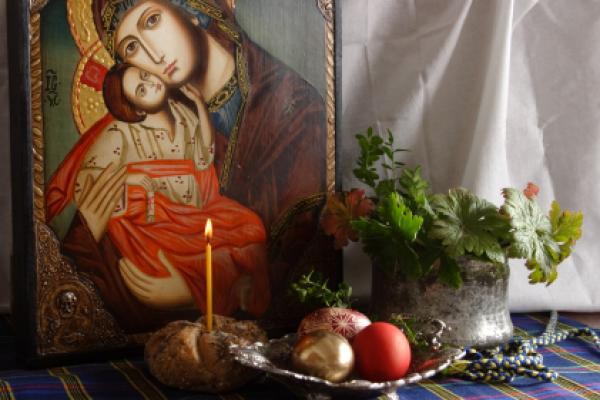
The Orthodox Expression of Christianity

The Orthodox Church represents one of the most beautiful, and rich expressions of Christianity. Though there are many variations in style depending on the country of origin (Greek, Russian, Serbian, Ethiopian, etc), members are fully united in faith and
in practice are slight, and in general, an Orthodox Christian can travel the globe and feel familiar with the services even if he is unfamiliar with the language spoken at a particular church.
Historically, the Roman Emperor Constantine was the first to sanction tolerance of Christians, in the year 330AD. He moved his capital to the Greek city of Byzantium and re-named itConstantine’s City, or Constantinople, and convened the first Ecumenical Council to establish what constituted the right (or orthodox) Faith and what was heresy. The Western and Eastern Church remained in communion until 1054, known as the Great Schism. The Orthodox Church has not deviated from the original Faith since the time of the Apostles, keeping the tradition alive through those times until today. Today, there are nearly 300 million Orthodox faithful.
In the 18th Century,  Russian Orthodoxy came to North America, where a Russian church was built on Kodiak Island in Alaska, (Alaska being part of Russia until the United States bought the land), with a small group of missionaries landing on Kodiak Island, Alaska in 1794, bringing to the New World the Orthodox Faith of the Apostles. Over the next two hundred years, with the help of immigration from Europe and the Middle East, the Apostolic Faith spread throughout the North American continent.


The establishment of the Greek Orthodox Church in the Western Hemisphere came with the first Greek colonists landing in St. Augustine, Florida, the oldest city in America. The first Greek Orthodox Church was eventually built in 1864
in New Orleans, Louisiana by a small group of Greek merchants!


Monday, April 2, 2012

Casanova and the Art of Seduction

This morning I was looking at an interesting blog about Giacomo Casanova (2 April 1725 – 4 June 1798) and his association with Herr Mozart.

Interesting stuff. Of course, Casanova, besides his fame with the ladies, was an exceptional librettist and wrote for Mozart's operas. for those who are unfamiliar, the librettist is the one who writes the words for a dramatic musical work, like an opera or musical play. He is, in effect, the screen writer, if he was working on a film.
Anyway, it is said Casanova met Mozart in Prague in 1787, that Casanova worked on the libretto for Don Giovanni, Mozart's greatest opera.Don Giovanni is perhaps Mozart's most famous operatic work, though at the time, it was not as successful as some of his other more light-hearted pieces, but it has stood the test of time for its drama, its range of musical offering, and its subject.

The subject matter, of course, deals with a compulsive Lothario not at all unlike Casanova, who supposedly bedded thousands of willing women. In his autobiography "The Story of My Life" , written later in his life, he wrote, "There is no honest woman with an uncorrupted heart whom a man is not sure of conquering by dint of gratitude. It is one of the surest and shortest means." He did not rely on alcohol as a tool for seduction. He, instead, worked on being attentive, giving small favors to soften a woman's heart. He said, "A man who makes known his love by words is a fool", but he cautions that verbal communication is essential...without speech, the pleasure of love is diminished by at least two-thirds”—but words of love must be implied, not boldly proclaimed. He also stated that mutual consent was important. He strove to be an ideal escort, being witty, helpful, a confidant, and working his way, later on, eventually into the bedroom, at a woman's bidding.

When Mozart met Giacomo, Mozart was 31; the other 62! You can imagine the young musician enthusiastically encountering this famous man, willing to work on his libretto. You can imagine the stories shared! It must have been an exciting collaboration.

If you want to see a wonderful production of Don Giovanni on DVD, check out the Paris Opera production (see below) with starring Ruggero Raimondi, Kiri Te Kanawa,John Macurdy, Edda Moser. It's filmed on location in Vicenza, Italy, with fabulous vistas of the Italian countryside. It's breathtaking.


If you want to see a charming portrayal of Casanova, check out Heath Ledger in "Casanova". It's light-hearted, with wonderful costumes, again filmed in charming environs, and Ledger is absolutely beautiful! (What a loss that he is gone now).

If you want to hear some beautiful, dramatic music from the opera, see below:
Herbert von Karajan plays with the Vienna Philharmonic Orchestra!